


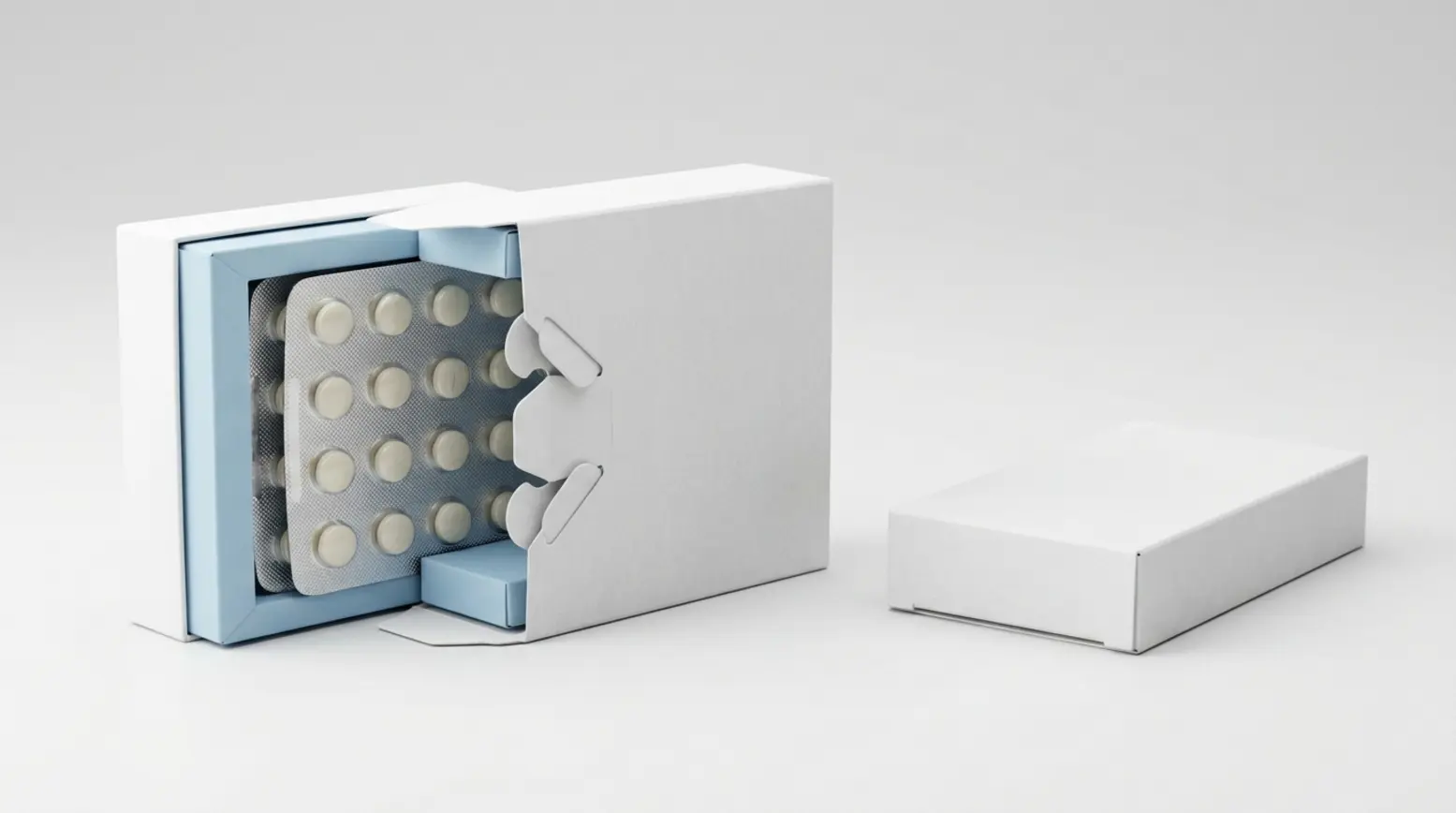

Typically, the question of whether secondary packaging counts as child-resistant in the US requires a careful answer: no, a standard removable carton does not count on its own. It only counts when it is part of a tested child-resistant packaging system that the consumer actually receives and uses. In practice, the exact pack configuration determines the claim, because US regulations focus on the package that physically controls access. You can see an example of this in our child-resistant carton for blister strips, where the carton and tray work together around the blister.
• A standard outer carton is typically considered secondary packaging and is child-resistant in name only; therefore, it does not automatically meet US child-resistant regulations.
• A carton can count when it is part of a tested child-resistant carton-and-blister system, provided the final design matches the test evidence.
• The key question is simple: which package controls access in the format the consumer actually uses?
• If the blister is removed from the carton and used independently, the carton usually no longer supports a child-resistant claim.
• Before launching, always compare the final consumer pack, opening method, and instructions with the tested configuration.
Direct answer: Does secondary packaging count as child-resistant?
In most cases, an ordinary carton does not count by itself. Anyone asking whether a carton is child-resistant should start with that point. However, the question of whether secondary packaging counts as child-resistant can be answered with a "yes" in one specific situation: the carton is integrated into the tested pack system, the safety function remains active during use, and the final delivered pack perfectly matches the test evidence. This is why the answer depends on the complete package system, rather than just the word "carton."
Why asking if secondary packaging counts as child-resistant depends on the immediate package
For US projects, the practical logic stems from the Poison Prevention Packaging Act (PPPA) and its focus on immediate packaging. In plain terms, the immediate package is the one that controls access for the consumer. This distinction helps explain the difference between primary and secondary child-resistant packaging for blister products. If a carton is merely a loose box around the blister, and the user removes the blister before taking their doses, that carton usually does not qualify under 16 CFR as the primary child-resistant component. Because of this, a loose outer box is fundamentally different from an integrated child-resistant outer packaging system.
What "immediate package" means in practice
The pack must control access in the exact form the consumer receives and uses at home. If a consumer opens the box once, throws it away, and keeps only the blister, then the blister is the component that matters most in practice. This is why real-world usage is critical. Technical drawings, early samples, or sales and marketing wording do not determine compliance on their own.
Why a normal carton is usually not enough
A standard carton protects the product, carries branding, and holds printed information. That role alone, however, does not make it child-resistant. If it can be easily separated from the blister, it functions merely as secondary packaging. In that case, the answer to whether secondary packaging counts as child-resistant is typically no, unless the carton is part of a tested system that remains integral to both opening and reclosing.
When does secondary packaging count as child-resistant for blister packs?
A carton can count when it is engineered as an essential part of a tested child-resistant blister pack. In this type of child-resistant carton-and-blister design, the safety mechanism is built into the carton and tray surrounding the blister, requiring the user to navigate the entire system before reaching the dose. Our child-resistant blister packaging guide explains this system in more detail and shows why the carton serves as far more than just printed outer packaging in this setup.
Connected packaging components and why they matter
Connected packaging components matter because they ensure the safety function remains active during use. In our carton design, the parts stay connected during both opening and reclosing, so the system consistently controls access every time it is used. The opening action requires two diagonal push points to be pressed simultaneously. This is very different from a simple box that is removed and immediately discarded. A connected design aligns perfectly with the "immediate package" logic for blister products, as the carton and tray continue to function together as the actual pack the consumer interacts with.
Why this is different from putting a blister in any carton
Placing a standard blister inside a regular carton is not the same as utilizing a tested child-resistant carton. The true difference lies in the locking method, the physical connection between the parts, the specific opening steps, and the way access is ultimately controlled. A claim that a blister-in-carton is child-resistant can only be valid when the complete system has been tested in that exact format. Therefore, calling outer packaging "child-resistant" relies heavily on engineering design and verified evidence, rather than mere marketing terminology.
The practical difference is easy to see. A removable carton typically acts only as secondary packaging, meaning it does not control access in daily use. Conversely, an integrated child-resistant carton system can legitimately count when it keeps the parts connected, actively controls the opening process, and perfectly matches the tested final pack.
A simple comparison: Does secondary packaging count as child-resistant?
| Pack setup | What controls access | Usually counts as child-resistant |
|---|---|---|
| Ordinary removable carton with a blister inside | The blister (after the carton is removed) | Usually no |
| Integrated, tested carton and tray system around the blister | The connected carton system during opening and reclosing | Yes, provided the exact tested design is used |
| Pack modified after testing | Depends on what changed and what reaches the consumer | Needs review |
What proof is needed to show that secondary packaging counts as child-resistant?
The claim heavily depends on rigorous testing and documentation for the exact design. The opening method, locking mechanism, paperboard choice, printed instructions, blister fit, and final pack setup must all match the formal evidence. This is why it is much safer to review the exact certified child-resistant design rather than relying on a broad, generic statement about all cartons. For US-based projects, teams often refer to F=1 compliance under 16 CFR 1700.20. For Europe, securing ISO 8317 evidence is a distinct, separate route.
US evidence and European evidence are not the same
Proof of compliance for the US and Europe should be verified separately because they adhere to entirely different standards. A packaging design holding ISO 8317 or EN 8317 certification for Europe still requires specific US evidence to be compliant in the United States. In our product range, both the Carton and the Wallet Box are fully certified to ISO or EN 8317, as well as to F=1 under US 16 CFR 1700.20. This dual certification helps teams working across international markets; however, the compliance claim still belongs exclusively to the exact tested design, not to every variation built from the same core concept.
Design changes can affect the claim
Even minor changes can matter significantly. If you alter the tray, locking area, material, printed instructions, or the way the blister fits inside, the entire pack may require a new assessment for retesting. The same rule applies if the final consumer pack is altered after filling, repacking, or distribution. Because of this, product teams should always carefully compare the final launch pack with the tested evidence prior to release.
How does secondary packaging count as child-resistant in real use?
The answer also depends on what happens after the product is packed and delivered. The consumer must receive and actually use the pack in its tested configuration. If the blister is intentionally removed from the carton system and stored alone, the child-resistant mechanism built into the carton no longer controls access in the intended way. Therefore, we do not claim protection once the blister is separated from the tested system. This point is especially important for pharma, nutraceutical, and cannabis blister formats, where different dispensing practices can inadvertently alter the actual consumer pack.
What pharmacies, repackers, and brand owners should check
These stakeholders must confirm which version of the package actually reaches the consumer. If a pharmacy, contract packer, or brand owner modifies the setup, the structural package type may change as well. This modification can directly affect whether the pack still satisfies the tested child-resistant claim. Ultimately, the safest approach is to evaluate the real consumer pack rather than relying on a generic sales description found on a supply document.
Why senior-friendly opening still matters
Adults must still be able to access the medication effortlessly, making child resistance only one part of the job. In formal testing, fewer than 1% of 300 children were able to open the pack, whereas 100% of seniors opened it within five minutes. This balance is vital because a truly compliant pack must successfully protect children while remaining highly usable for older adults.
A practical route for blister packs that should remain unchanged
For many projects, the main benefit is remarkably simple: child-resistant access can be seamlessly added around the existing blister, provided the format fits the tested platform. This means the blister strip itself can stay physically unchanged, while the surrounding carton and tray system provide the necessary child-resistant functionality. Our US child-resistant blister packaging route supports this innovative approach and runs efficiently on standard cartoning lines at normal production speeds. If a more comprehensive packaging chain is required, Ecobliss Pharma and our wider group can support all related steps surrounding the pack.
FAQ
Is a carton child-resistant by itself?
Usually, no. A normal carton does not automatically count as child-resistant. It only counts when it is an integral part of a tested child-resistant package system, and when the final manufactured design flawlessly matches the test evidence.
Can a child-resistant claim for a blister in a carton be valid?
Yes. However, the complete design must be thoroughly tested as one unified pack system, and the blister must remain inside that child-resistant system during normal consumer use.
Does child-resistant outer packaging always count under the PPPA?
No. The exact role of the package matters greatly, as does the tested design. An outer pack can successfully support the claim only when it is a structural part of the package that physically controls access in the exact form the consumer actually uses.
What should I compare before launch?
Always compare the exact blister format, opening method, locking action, connected packaging components, printed instructions, and final consumer pack setup. If any of these critical points differ from the tested design, the compliance claim should be reviewed carefully.
Check your pack against the tested configuration
If you need a clear answer for your blister product, always compare the full intended pack with the tested configuration first. That is the absolute safest way to judge whether the compliance claim can be used for your project. When you are ready, you can request a free sample and share your blister format and intended pack setup with our team.
Request a free sample now!


