


US child-resistant packaging, certified to 16 CFR 1700.20
- Certified to F=1 under US 16 CFR 1700.20 and to ISO 8317
- Fits the blister you already use, no primary packaging change
- Senior-friendly and runs on standard cartoning equipment




Meeting 16 CFR 1700.20 should not mean redesigning your blister
If your product falls under the Poison Prevention Packaging Act (PPPA), the CPSC requires special packaging that passes the test in 16 CFR 1700.20. For many US pharma and Rx teams, that requirement arrives after the blister is already developed, validated, and registered.
Most routes to compliance touch the primary packaging: new lidding, a new blister format, new tooling, and new validation work. Locked4Kids takes a different route. The child resistance is engineered into the carton or the Wallet Box, so the blister you already use stays exactly as it is.
Not sure your product is in scope? Start with our guide to which products need child-resistant packaging in the US.

How the child resistant carton works
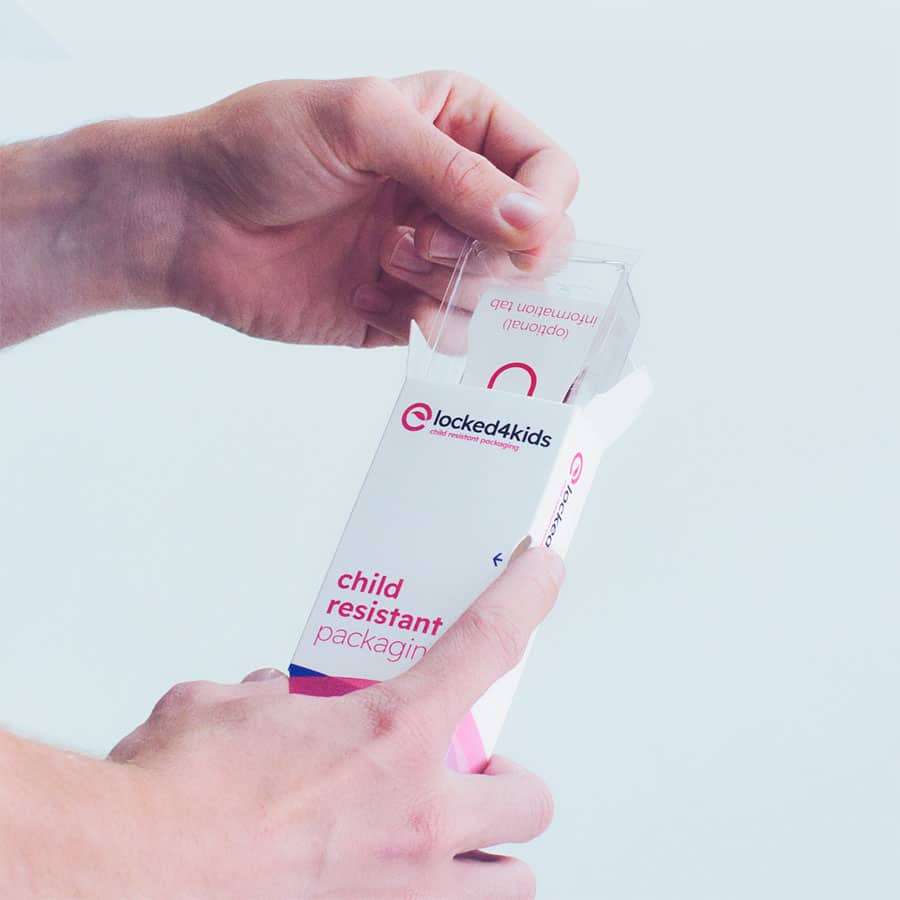
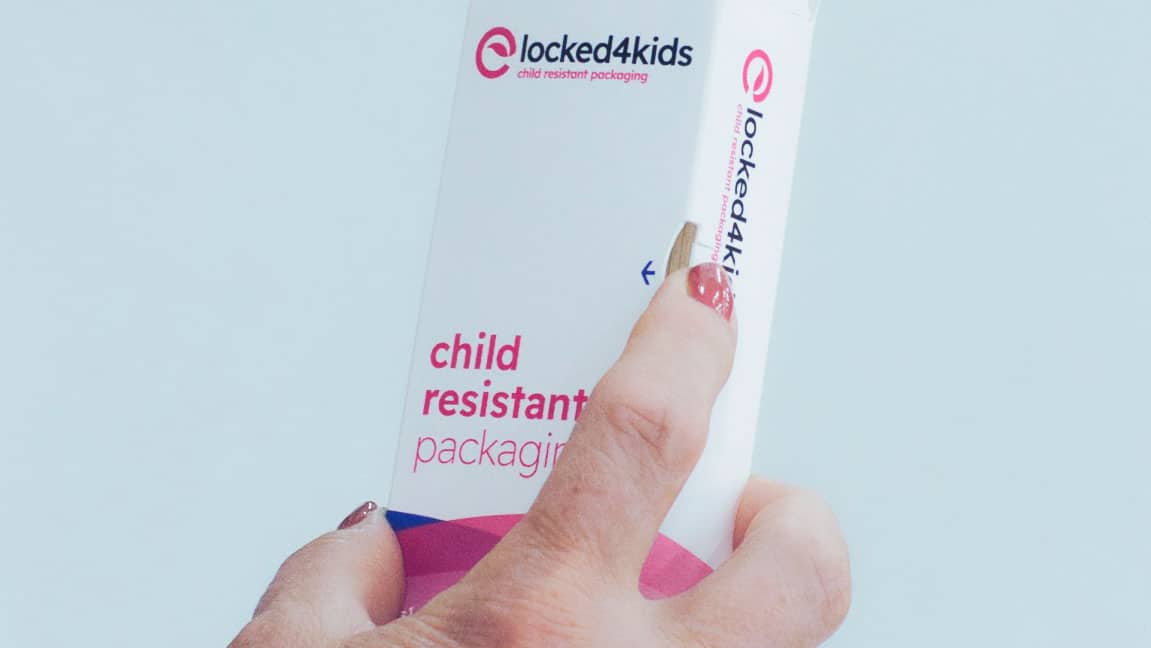
Your blister strips sit in a tray inside the carton. The tray slides out like a drawer, but only when two hooks on top of the carton are pressed at the same time. The hooks are placed diagonally, on opposite sides.
Children cannot open it. They do not understand the mechanism, and their hands are too small to reach both hooks at once. An adult opens it in one simple movement. Because every component stays firmly connected, the pack closes again and stays child resistant for the full course of treatment. The platform is compatible with around 95% of blister packs on the market.

Certified to F=1 under US 16 CFR 1700.20
The packaging is certified to F=1 under US 16 CFR 1700.20 for the United States and to ISO 8317 for Europe, so one pack covers both markets. Testing was carried out at BVI in Belgium, an ISO 17025-accredited laboratory.
In a panel of 300 children, fewer than 1% opened the packaging before a demonstration and fewer than 4% after two five-minute rounds, against regulatory thresholds of 15% and 20%. And because a pack that stops an older patient is a failed pack, senior accessibility was tested too: every senior tested opened the packaging successfully, against the 90% regulatory minimum.
See the full test setup and results on our certification page.
No new production line. No speed penalty.
The carton is built for high-speed automated production on standard pharmaceutical packaging equipment, including lines from Romaco, Uhlmann and Pentapack. Blister strips are loaded and inserted at the same speed as regular, non-child-resistant cartons.
The design can be customized to your product: single or multiple strip locking trays, clamshell designs, window packs, and inner or outer lidding. Both highly automated production and smaller hand-assembled runs are possible, so large and limited volumes both work.
What to expect from your US CR packaging project
You request a free sample
Tell us your blister format. We send a sample carton at no cost, so your team can hold it, open it and test the two-hook mechanism for yourself.
We design the child resistant carton around your blister
Our team analyses your product and designs the carton to fit your existing blister, then builds a prototype for you to test and approve. This is the development phase.
We prepare tooling and artwork for your line
Artwork placement and production tooling are set up and made ready for your packaging line. This is the realization phase.
We assemble and seal, with on-site support
Assembly and sealing run on standard cartoning equipment at regular production speed, with on-site support during implementation.
See the F=1 certified pack for yourself
Tell us your blister format and we send a free sample at no cost. Ready for a quote? Request it from Ecobliss Pharma. Prefer to talk first? Call us at +31 475 390 550.
Questions US packaging teams ask about 16 CFR 1700.20
Is the packaging certified to US 16 CFR 1700.20?
Yes. The packaging is certified to F=1 under US 16 CFR 1700.20, the CPSC test protocol used for special packaging under the Poison Prevention Packaging Act. It is also certified to ISO 8317 for Europe.
What does F=1 mean?
F=1 is a setting in the US 16 CFR 1700.20 test: opening or reaching a single unit already counts as a failure, the strictest setting for unit-dose packs such as blisters. It is separate from the child panel result. Our own panel result is on the certification page.
Was senior accessibility tested?
Yes. Every senior tested opened the packaging successfully, against the 90% regulatory minimum. The opening action needs no strength.
Do we need to change our blister or lidding?
No. The child resistance is in the carton. Your primary blister integrates as it is, with no modifications needed. The platform fits around 95% of blister packs on the market.
Who performed the testing?
Testing was carried out at BVI in Belgium, an ISO 17025-accredited laboratory, with a panel of 300 children and a senior panel.
Will it slow down our packaging line?
No. The carton runs on standard cartoning equipment at the same speed as regular, non-child-resistant cartons.
Can we get a sample first?
Yes. Tell us your blister format and we send a sample at no cost, so your team can evaluate the pack before any commitment.
Which US rules apply to child-resistant packaging?
The Poison Prevention Packaging Act (PPPA) is the law and the CPSC administers it. The rules are in 16 CFR Part 1700: section 1700.14 lists the products that need special packaging, 1700.15 sets the performance levels, and 1700.20 describes the test. Read more in our guides to the PPPA, the CPSC rules, and 16 CFR 1700.20.
What are the pass levels in the 16 CFR 1700.20 test?
At least 85% of the children may not open the package before a demonstration, and at least 80% may not open it after. At least 90% of the senior adults must open it. In our test, fewer than 1% and fewer than 4% of 300 children opened the packaging, and every senior tested opened it.
Who handles quotes for US projects?
Quotes and contract packing for Locked4Kids are handled by Ecobliss Pharma, part of the same Ecobliss Packaging Group. Request a quote from Ecobliss Pharma.
Get the solution you need
Find out how we can help. Give us a call.


