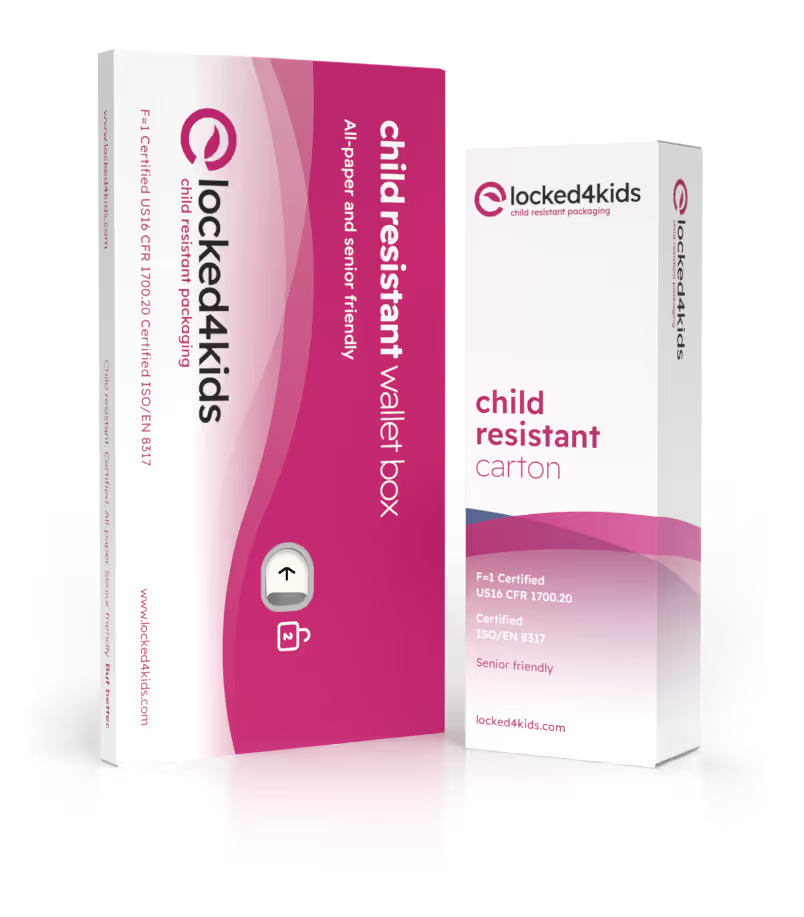
Locked4Kids cartons are unique. While preventing opening by young children, adults are able to open the cartons easily.
Senior friendly means that adults aged 50 to 70 can open the pack. Under 16 CFR 1700.20, at least 90% of them must succeed. Medicine packs need both child resistance and senior friendliness, because seniors are often the main users.
In the certification process, the pack is first tested with children. The pack is then evaluated for ease of use with adults.
The Locked4Kids Wallet Box is tailored for senior ease of use. Our testing shows a striking balance between safety and accessibility: not a single child managed to open the box during the first five minutes, yet all seniors could open it effortlessly.
The design ensures that seniors can access their medications without hassle. The opening mechanism is straightforward, avoiding complex motions or the need for strength that seniors might find challenging.
Making the Wallet Box senior-friendly is key to our approach. We want to make sure that while children are kept safe, seniors won't struggle with unnecessary barriers when accessing their health essentials.
On the carton, an adult presses two hooks on the top at the same time and pulls the tray out like a drawer. Children have difficulty with the carton because they do not understand how it works, and their hands are too small to handle it. After use, the user can close the carton again, and all parts stay connected. The next generation of the carton, Locked4Kids 2.0, reached 100% senior friendliness by finetuning the hook mechanism.
The Wallet Box opens only when designated points are pressed at the same time. Adults do this easily; for children the action is too complex. The Wallet Box opening needs no strength, so it stays accessible for older patients. The wallet inside the box has space to present patient instructions and warnings clearly. A simple third interactive element let the Wallet Box pass the child safety tests and reach perfect scores in the senior-friendly tests under US protocol 16 CFR 1700.20.
Test setup and results are described on the certification page.