


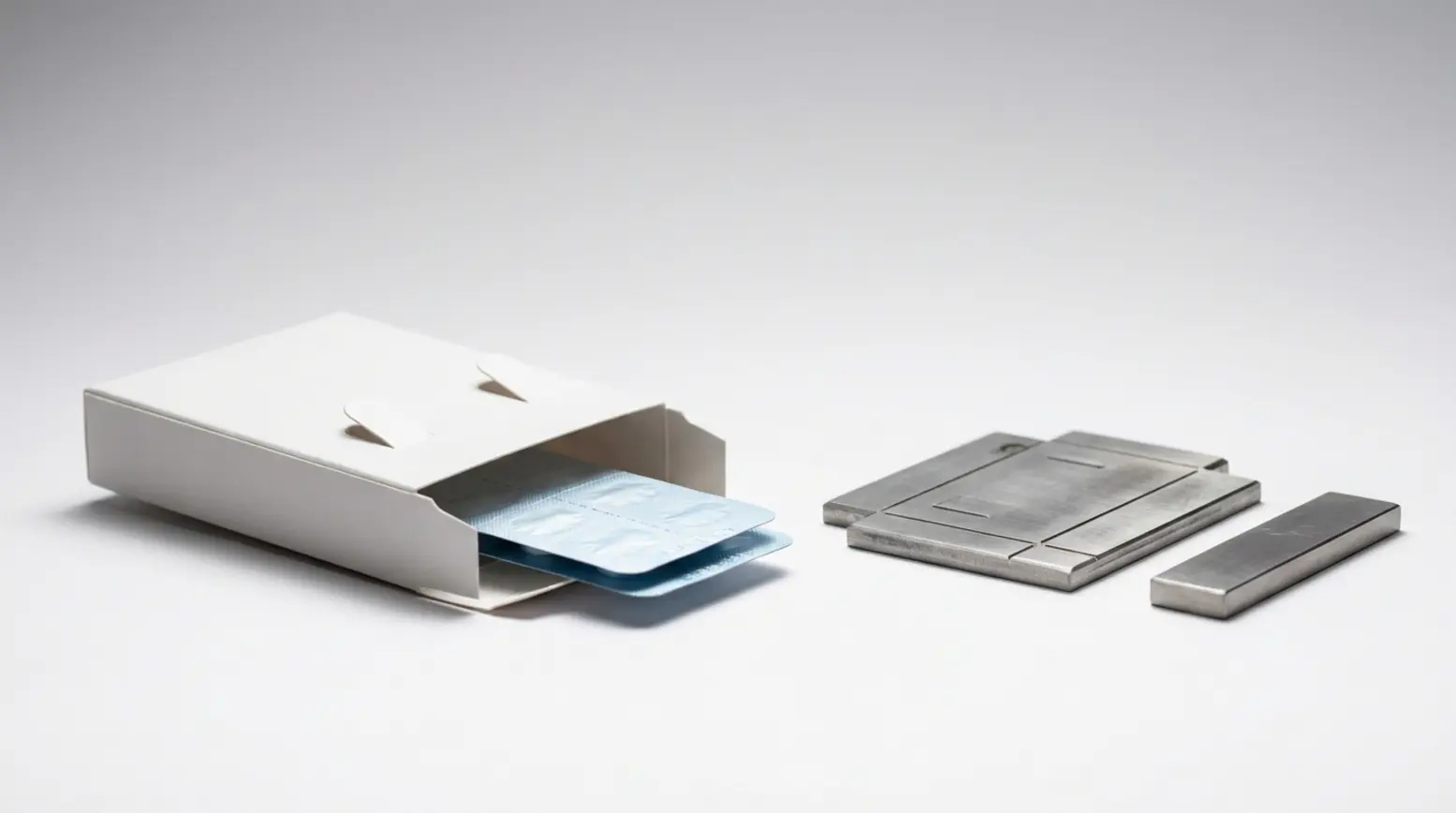

Tooling and format parts for CR cartons are the physical tools and machine components required to properly manufacture and run a child-resistant carton. In simple terms, carton tooling creates the blank, while cartoner format parts allow the machine to handle both that blank and the blister format. These elements are critical early on because they influence tooling costs, ownership, transfer rights, machine compatibility, and change control long before supply terms are finalized.
• Carton tooling and cartoner format parts are distinct items; therefore, they should be priced and reviewed separately.
• A certified child-resistant carton still requires physical tools and machine-specific setup parts to ensure repeatable production.
• Ownership, maintenance, storage, and transfer rights must be agreed upon in writing prior to placing an order.
• Structural changes can impact the approved design, meaning they may require technical review and retesting.
Why tooling and format parts for CR cartons matter in a child-resistant project
Our carton serves as a useful example because it is a certified child-resistant solution for blister strips, featuring two diagonal push points. It runs on standard packaging lines at normal speeds, and you can view the product format on our child-resistant carton page. Our packs are certified to ISO/EN 8317 and achieve an F=1 rating under 16 CFR 1700.20. All parts remain connected after opening, which is particularly important for US primary packaging regulations. Even with an established design, production still requires the correct die, creasing setup, and machine support parts to ensure the format runs in a stable, repeatable manner.
These project assets are often separate from the recurring unit price of the carton. As a result, procurement, packaging engineering, and operations teams should inquire about them from the very beginning. If they are overlooked in the initial quotation, one-off costs can surface later in the form of cutting and creasing tools, cartoner change parts, qualification work, or machine adjustments. In child-resistant packaging, geometry is crucial because the opening mechanism relies on a controlled shape and precise folds. Consequently, design control must be established before any tools are released for production.
What tooling and format parts for CR cartons include
What carton tooling is
Carton tooling is used to manufacture the flat carton blank. A folding carton cutting die cuts the outer shape, along with any necessary openings or special features. This die-cutting step transforms the approved drawing into a physical blank that can subsequently be folded, filled, and closed exactly as intended. Meanwhile, carton creasing tooling creates the fold lines. These lines dictate how the board bends, ensuring the carton opens and closes correctly both on the packaging line and during consumer use.
This is especially critical in child-resistant packaging, as specific aspects of the shape form the opening mechanism. The approved geometry is therefore much more than a mere visual outline; it fundamentally drives how the pack performs. For a broader understanding of how the blister and outer pack function together, explore our child-resistant blister packaging guide. The key takeaway is simple: tooling must precisely reproduce the controlled drawing and specified materials without introducing uncontrolled structural changes.
What cartoner format parts are
Cartoner format parts are machine-side components, settings, or adjusted fixtures utilized on the cartoning equipment. They guide, carry, push, erect, or close a specific carton and product format. Depending on the machine, a format set might include entirely new physical parts, modified settings, or updates to existing components. Consequently, an existing packaging line may still require new or adjusted parts when a new format is introduced.
Teams often confuse these two distinct subjects. Carton tooling creates the blank, whereas format parts enable the machine to process that blank and its blister correctly. This is why any pharmaceutical packaging tooling review must cover both sides of the project. The fact that a pack runs on standard pharmaceutical cartoning equipment does not eliminate the need to verify exact machine compatibility, handling points, and setup requirements for the chosen format.
How tooling and format parts for CR cartons connect to certified design control
In a child-resistant pack, controlled geometry is vital because the opening mechanism relies entirely upon it. If the shape, a fold, a lock point, or any other key dimension changes, the pack may no longer reflect the approved design. Because of this, tooling and format parts for CR cartons should be reviewed as a core element of design control rather than being treated simply as standard workshop items. Even small structural modifications can raise significant compliance and performance issues.
Certification applies to the packaging design, not to the die itself. The tooling must faithfully reproduce the controlled die line and the agreed-upon material specification. If a team decides to move a lock feature, reduce a panel size, or alter another critical detail, the certified status of the pack could be compromised. Our resource on certified child-resistant packaging explains this certification basis in greater depth. Ultimately, the practical message is clear: any structural change can necessitate retesting.
Starting with an established, certified design gives teams a much more controlled foundation than developing a new child-resistant mechanism from scratch. However, it does not eliminate the need for tooling, formal approvals, or thorough process reviews. It simply means the design's baseline is already defined, allowing the project team to focus on reproducing it accurately and properly documenting that control.
One-off cost, recurring price, and tooling and format parts for CR cartons in commercial review
What usually sits in one-off cost
One-off costs typically include cutting and creasing tools, machine format parts, and project-specific setup or qualification work. These assets are manufactured or prepared exclusively for a single packaging format. Because they are distinct from routine carton supply, they should be itemized clearly in the quotation. Doing so helps teams fully understand the true tooling costs before giving approval and minimizes the risk of unexpected expenses later on.
What usually sits in recurring supply
The recurring price generally covers per-unit carton production and ongoing supply. In certain agreements, wear items or replacement support might also be included, though this must be explicitly stated in writing. Teams should never assume that future maintenance, extra cartoner change parts, or updated format sets are automatically covered. A robust packaging tooling contract clearly separates the immediate project scope from any optional future costs.
Questions procurement should ask
Procurement should always clarify who pays for the die, who pays for the machine format parts, and who legally owns each item once payment is complete. They should also ask where the tools will be stored, who is responsible for maintaining them, how final acceptance will be documented, and whether transferring these assets to another supplier or site is permitted down the line. Asking questions about packaging tooling ownership is crucial because paying for a tool does not automatically equate to owning it. Furthermore, the agreement should clearly state what happens to each project asset if the supply relationship eventually ends.
Comparison point: Carton tooling makes the blank and is typically a one-off project asset tied directly to the approved drawing.
Comparison point: Cartoner format parts help the machine run the format and are generally one-off or project-specific investments.
Comparison point: Recurring carton supply covers the actual cartons and should always be priced separately from tooling assets.
Comparison point: Ownership and transfer rights are significantly more important for tooling and machine parts than for standard carton deliveries.
What changes packaging tooling lead time for tooling and format parts for CR cartons
The lead time for packaging tooling depends on several practical inputs. The approved drawing, the material specification, and the final production method all play critical roles. On the machinery side, the exact cartoner configuration and specific product format also impact the timeline. Because of these variables, teams must freeze all structural decisions before production tools are released. Doing so dramatically lowers the risk of rework and keeps project planning clear and predictable.
Late artwork changes do not inherently require new tooling. If only the print changes while the structure remains identical, the die and crease layouts can usually stay the same. Structural changes are entirely different, as they frequently affect the cutting die, the carton creasing tooling, machine handling points, and qualification requirements. Therefore, teams are well-advised to separate artwork approval from structural approval during the project planning phase.
Supplier changes, transfer risk, and tooling and format parts for CR cartons
What to verify before assuming a tool can move
A supplier change should never begin with the assumption that the original tooling can simply be transferred. First, firmly establish legal ownership. Next, verify the tool's physical condition, process compatibility, and qualification needs, while confirming the new process can accurately reproduce the controlled design. This is a vital component of any risk review, as legal transfer rights do not guarantee a technical fit.
Technical and commercial reviews must go hand in hand during this phase. A tool may legally belong to one party yet completely fail to suit another supplier's production setup. Machine format parts can be even more site-specific since they depend on the exact cartoner and the product's path through the machine. As a result, a transfer might involve partial part replacement, extensive new adjustments, or fresh approval work, even if the intended carton design remains completely unchanged.
What stays the same and what still needs proof
The certified design remains the ultimate reference point. Manufacturing controls must still demonstrate that the approved design is being reproduced correctly, using the proper materials and process settings. Existing tooling may transfer successfully, or it may not. Likewise, existing format parts might be fully reusable, partially reusable, or require complete replacement. Ultimately, a supplier change can preserve the same design intent while still generating new technical tasks and commercial decisions.
A pre-signing checklist for tooling and format parts for CR cartons
Before signing an agreement, ask for the controlled carton drawing, the comprehensive material specification, and a clear tooling description. Identify all expected machine format parts separately from the main carton supply. Confirm which party is responsible for supplying each item, how final acceptance will be recorded, who owns the assets post-payment, and whether transfer rights apply in the future. Ensure that cost-reduction requests do not trigger uncontrolled structural changes, as these modifications can negatively impact the approved design and elevate future supply risks.
For many teams, this checklist works best when procurement and engineering review it collaboratively. This approach ensures that technical fit and commercial responsibility are evaluated simultaneously. If you would like us to review a drawing, tooling list, format parts list, quotation breakdown, or ownership clause before you place an order, please contact us, and we will gladly review the project details with you. Where a broader packaging scope is required, the group behind us, Ecobliss Pharma, can also provide support in areas such as design for manufacturability, contract packing with serialization, and specialized machinery assistance.
Common questions
Are carton tools and cartoner change parts the same thing?
No. Carton tools make the flat blank. Cartoner change parts, conversely, help the machine process that blank and the blister format. While they are intrinsically linked within a single project, they are separate physical items that present different cost, ownership, and compatibility considerations.
Does a certified child-resistant carton remove the need for tooling?
No. A certified design still requires precise physical tooling to accurately reproduce the approved geometry. It may also demand machine-specific format parts so the packaging line can run the format correctly and consistently over time.
Can a supplier change be made without affecting the certified design?
It is possible, but it should never be automatically assumed. The design can remain identical in principle, but the new supplier must still reproduce it flawlessly using the correct materials and rigorous process controls. Ownership, machine compatibility, tooling condition, and formal approval checks should all be thoroughly reviewed first.
Do late artwork changes always mean new tooling?
No. If the physical structure stays the same, artwork updates generally will not affect the tooling. If the structure changes, however, new or modified tooling is highly likely, and the certified status of the pack may also require a formal review.
Want Ecobliss to pack your product into Locked4Kids cartons, including serialization? Ecobliss Pharma handles quotes and contract packing: request a quote from Ecobliss Pharma.
Request a free sample now!


