


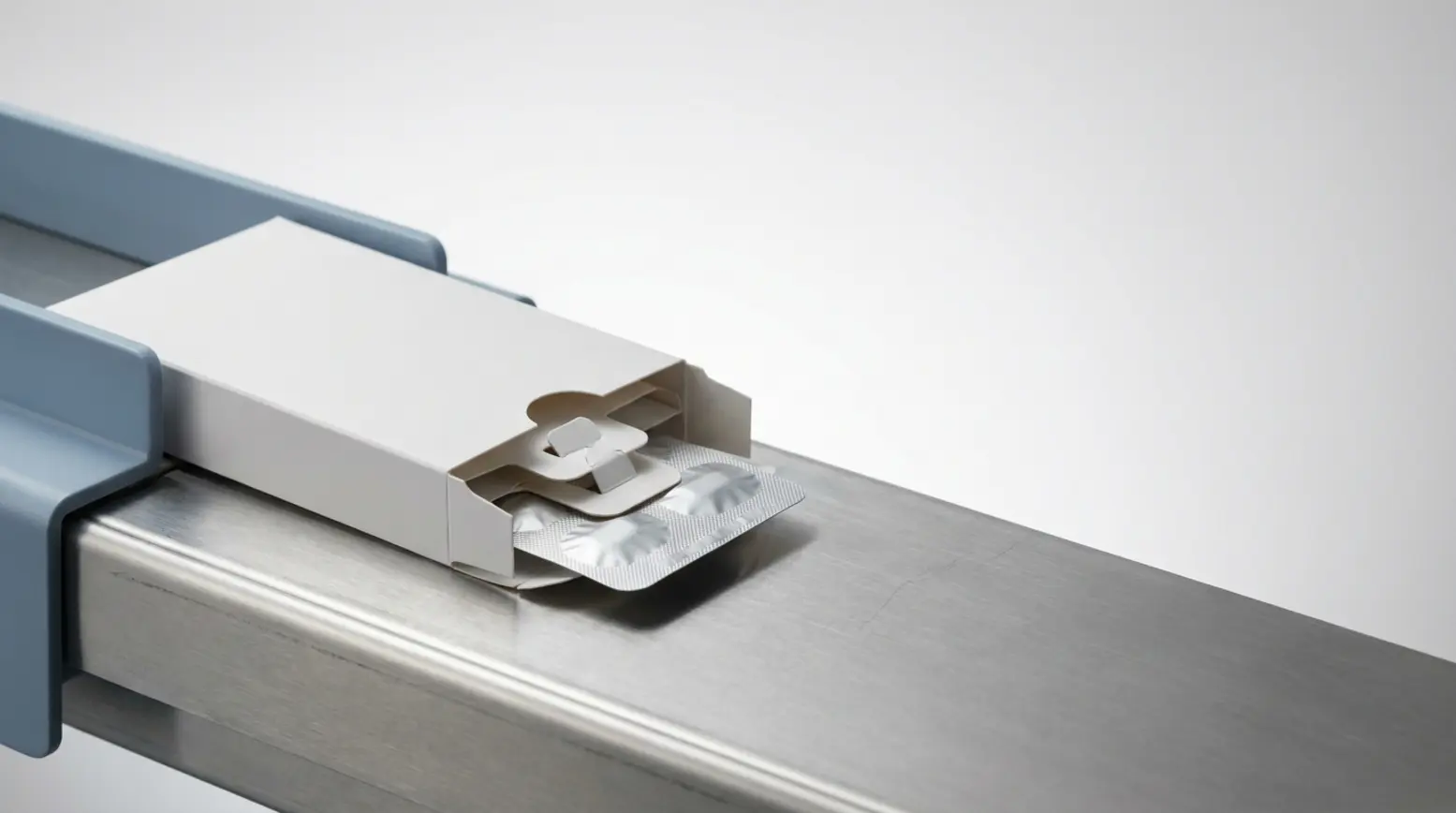

Usually, no. Child-resistant packaging does not have to slow your line, provided the format fits your machine and the line is set up correctly. Because our carton is designed for standard cartoning and pharmaceutical equipment, it is intended to run without a packaging speed penalty compared to a regular carton. However, actual results still need to be verified on your own line, as cartoning speed depends on the pack, the machine, the operators, and the entire production setup.
• Child-resistant packaging line speed depends on line fit and setup, not on a single feature alone.
• The child-resistant function is built into the carton, so there is rarely an extra step required for the blister.
• Real output should be judged based on stable speed, stops, rejects, changeovers, and packaging OEE.
• First-run losses do not always reflect long-term cartoning performance.
• Certification and line speed answer two different questions, meaning both must be verified.
Does CR packaging slow your line: the short answer
If you ask, "does CR packaging slow your line?" the practical answer is usually no. Our carton is designed to run on standard pharmaceutical cartoning equipment without a speed loss compared to a standard carton. This is a primary design goal; because the child-resistant feature sits within the carton itself, the line continues to handle a familiar cartoning process. Even so, no supplier should treat that as a universal promise. Real pharmaceutical line efficiency must always be verified on your actual machine, product, format, and campaign conditions.
This matters because line output is never dictated by a single number on a machine screen. While a cartoner might display a high nominal speed, true throughput depends on stable feeding, opening, insertion, closing, inspection, rejection, and precise timing across the entire line. Therefore, a fair review examines packaging line efficiency over time, rather than just focusing on top speed during a short run.
Does CR packaging slow your line when you look at the full packaging line?
Real line speed comes from the entire process. Product feed, carton feed, erection, insertion, closing, inspection, rejection, and machine timing all impact overall output. If a single step becomes unstable, the line slows or stops more frequently. Because of this, the slowest stable step often dictates production, even when the cartoner itself is capable of running faster.
This is why a machine's set speed and its stable production speed are fundamentally different. A machine might achieve high-speed cartoning for a short time, but that does not prove good day-to-day performance. Instead, teams should focus on sustained output with acceptable reject levels and a normal operator workload. Doing so provides a much more useful view of cartoning performance and total line efficiency.
Upstream and downstream equipment also play critical roles. Blister supply, vision systems, coding, case packing, and end-of-line handling can all become the true bottleneck. If output drops, the child-resistant carton may not actually be the cause. Full line data always provides a better answer than a narrow check of just one station.
Does CR packaging slow your line if the child-resistant function is built into the carton?
The design logic is highly important here. Our child-resistant carton with integrated opening mechanism keeps the child-resistant function entirely within the carton structure. As a result, the line does not require a separate child-resistant operation on the blister itself. In many cases, you can keep the existing blister unchanged if it fits the selected design, ensuring the main packaging project stays much simpler.
This approach supports normal cartoning line speeds because the process remains very close to a standard cartoning route. The line still handles a standard carton and blister combination, and there is no added process step to achieve child resistance on the primary pack. That is exactly why this format is intended to avoid a packaging speed penalty. Still, it remains necessary to run a line trial, as machine condition, board behavior, guides, and operator settings can all influence the final result.
Does CR packaging slow your line when setup and format integration are weak?
Speed loss can occur when machine fit and setup are weak. Cartons may feed poorly if board properties or magazine settings fall outside the machine's optimal window. Carton erection can become unstable, and insertion can vary if guides or pushers are not adjusted correctly. Additionally, the closing process can generate rejects if carton control remains inconsistent. These are common technical reasons for lost output, and they can affect absolutely any new format.
However, that does not mean child-resistant packaging has to run slowly. In most cases, these losses point to issues with machine and format integration, recipe settings, format parts, or overall operator familiarity. Therefore, when teams ask whether child-resistant packaging slows production, they should carefully separate normal startup issues from true format capability. Doing so helps procurement, engineering, and operations evaluate the business case using far better evidence.
First runs often look worse than later campaigns. A new format typically requires a period of normal tuning. Guides may need adjustment, recipes might be optimized, and operators generally need time to learn the necessary checks. As a result, early data can significantly understate long-term pharmaceutical line efficiency if a trial ends before the line has fully stabilized.
Does CR packaging slow your line: how to test it with your own OEE data
The best way to answer the question, "does CR packaging slow your line?" is to build a fair baseline and compare like with like. Start with your current carton under normal production conditions. Use the same product, a similar batch size, comparable operator experience, and identical line conditions wherever possible. Then, run the child-resistant format and compare the results. This approach provides a realistic view of child-resistant packaging line speed, rather than relying on a rough comparison between entirely unrelated runs.
During the trial, meticulously record stable machine speed, minor stops, reject rates, manual interventions, and changeover losses. These data points will reveal whether an issue is a genuine packaging speed penalty or just a normal setup learning curve. If possible, collect data over a long enough period to move well beyond initial startup behavior. A short run can easily miss repeated stops, emerging reject patterns, or necessary operator actions that ultimately affect total output.
Packaging OEE helps you read these results clearly. Availability demonstrates whether the new format creates more downtime or unexpected stoppages. Performance indicates whether the line can reliably hold its intended rate. Quality reveals if more packs are being rejected or require rework. When all three of these areas remain in control, the business case is generally much stronger, proving the line is working efficiently rather than merely running fast for a few minutes.
A second comparison after stabilization is often essential. Once settings, guides, quality checks, and operator routines naturally improve, the line may perform very differently. This subsequent run offers a much clearer picture of long-term cartoner throughput and overall packaging line efficiency.
• Baseline check: Use your current carton with normal product, batch size, and operator conditions.
• Trial check: Record stable speed, minor stops, rejects, manual interventions, and changeover time.
• OEE check: Review availability, performance, and quality together, as a single number alone can easily mislead.
• Repeat check: Run the comparison again after settings and operator routines have fully stabilized.
What proof should you ask a supplier for?
Ask whether the pack was specifically developed for automated pharmaceutical cartoning. You should also ask which board and carton parameters must match the machine's specification. Inquire about what trial material is available and what acceptance criteria should be measured during the test run. Good technical discussions will always cover speed, stops, rejects, manual interventions, and changeover results, as all of these variables directly affect cost and overall output.
Be careful with broad claims that every machine will run every format. That is simply not a reliable engineering answer. A truly useful answer explains the design limits, the specific machine fit, and the conditions required for stable cartoning performance. If wider support is needed regarding design fit, packing execution, or machine integration, Ecobliss Pharma and the Ecobliss Packaging Group can comfortably support those broader packaging activities throughout your project.
Why patient use and certification still come first
Production speed matters only if the finished pack maintains its tested geometry. A fast manufacturing result is not genuinely useful if the process changes the carton in a way that negatively affects its opening behavior. This is exactly why certified child-resistant packaging and line performance should be evaluated as separate topics. One confirms proper child resistance and adult usability, while the other confirms manufacturing fit and stable output.
Our carton and wallet box solutions are certified to ISO/EN 8317 and F=1 under US 16 CFR 1700.20. This certification matters because adults, including seniors, still need to be able to open the pack correctly without frustration. If the design changes in any meaningful way during production, further testing may be required. Therefore, any speed-related decisions must always protect the tested pack geometry and the intended user experience.
FAQ
Does child-resistant packaging slow production on every line? No. It heavily depends on the format design, machine setup, and how well the pack fits the line. A well-matched format can run at normal speeds, while a poor setup will likely create stops and rejects.
Can I keep my current blister? Often, yes. If the blister fits the newly selected design, the existing blister can frequently remain unchanged. This helps reduce the overall project scope and keeps the process much closer to standard cartoning.
What is the best way to compare formats? Build a solid baseline with your current carton, then run a matched trial with the child-resistant format. Record stable speed, stops, rejects, manual interventions, and changeover time. Finally, repeat the comparison after the new format has completely stabilized.
Can a fast line result still fail the business case? Yes. If downtime rises, rejects increase, or the finished pack no longer securely matches the certified design, the final result may still be weak. Raw speed is only one part of the overall decision.
What is the main difference between nominal speed and real output? Nominal speed is simply the set or displayed machine rate. Real output is what the line can steadily hold while accounting for normal stops, acceptable quality, and a manageable level of operator intervention.
Next steps for a feasibility review
If you want a realistic answer for your specific line, start by gathering your current speed, stop, reject, and changeover data. We can then use that information in an early strategy discussion to determine whether a machine trial makes sense before you commit valuable engineering resources. This keeps the next steps practical and helps your team stay focused on real production evidence.
Want Ecobliss to pack your product into Locked4Kids cartons, including serialization? Ecobliss Pharma handles quotes and contract packing: request a quote from Ecobliss Pharma.
Request a free sample now!


