


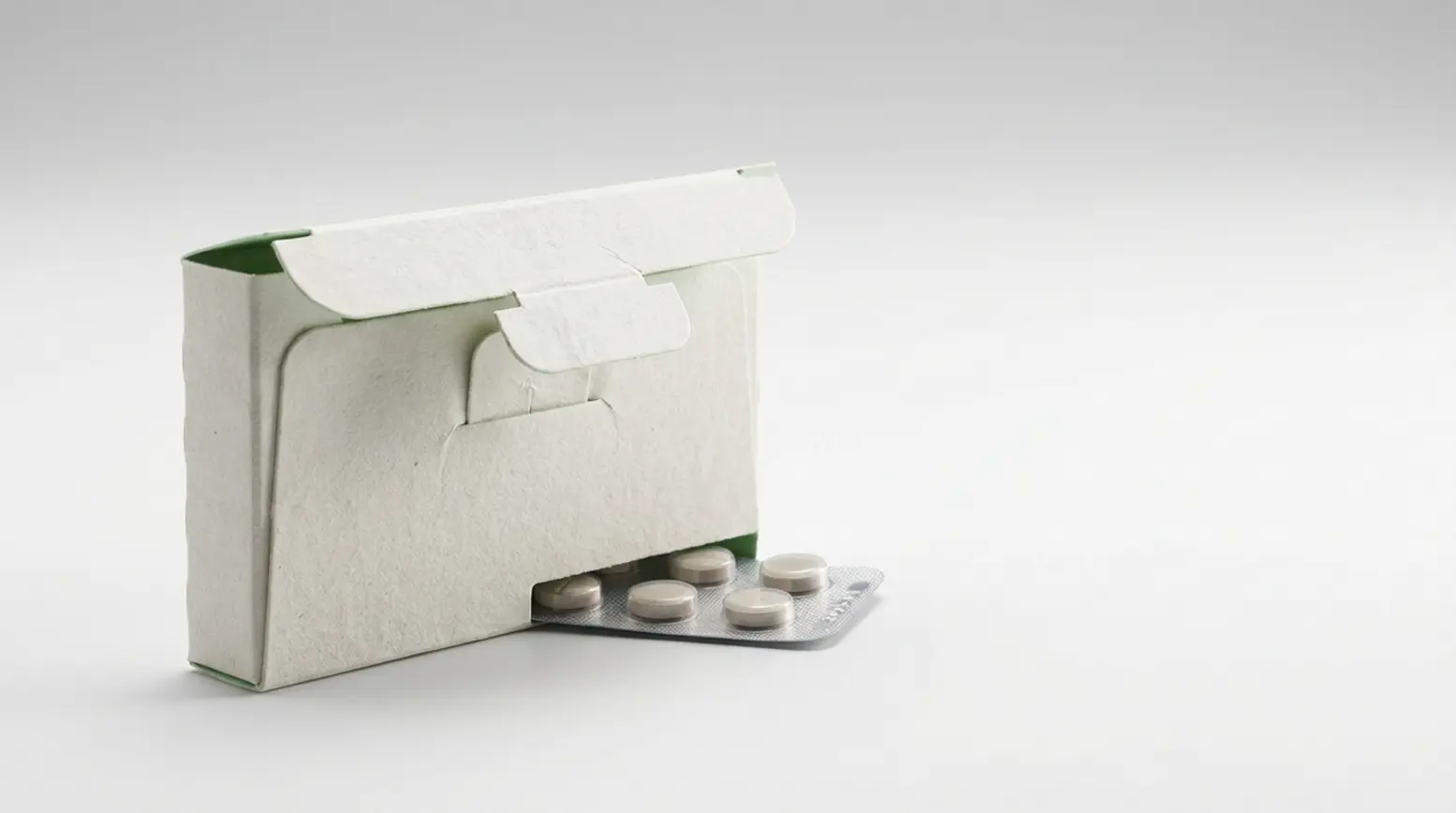

You can often reduce the amount of plastic used in cannabis packaging without compromising child resistance by updating the outer pack first. In many cases, the internal blister still performs the necessary barrier function, while the outer pack provides the child-resistant mechanism, printed information, and brand presentation. Because these functions are distinct, cutting plastic in cannabis packaging usually starts with the secondary pack rather than the blister. This is also the safest first step for many teams, as it supports goals for plastic reduction in cannabis packaging while keeping product protection and compliance reviews under control.
• Start with the outer pack, since the blister often still requires strong barrier performance against moisture, oxygen, or light.
• Child resistance is a performance test result, so it does not inherently rely on plastic.
• An all-paper secondary pack can reduce cannabis packaging waste, but it does not make the entire system plastic-free if the blister still contains plastic or aluminum.
• Certification applies to the exact pack design, meaning any change in material or geometry may require new testing.
• Adult usability matters as well, because a more sustainable pack still needs to be safe and easy for real patients to open.
Cutting plastic in cannabis packaging starts with the outer pack
When teams review cutting plastic in cannabis packaging, it helps to separate the pack into individual components and determine what each part actually does. The primary blister typically protects the product from moisture, oxygen, or light, while the secondary pack carries branding, legal text, tamper-evident features, and child resistance. Because these roles are distinct, the materials used do not necessarily need to be identical. This is why shifting to paper cannabis packaging is often more realistic to execute in the outer structure first.
One practical example is the all-paper child-resistant Wallet Box. The Wallet Box itself contains no plastic, allowing it to serve as an all-paper cannabis packaging component for the secondary pack. However, environmental claims must remain strictly limited to the box itself. They should not be applied to the full cannabis pack unless every part of the system supports that statement.
What the Wallet Box claim means
Clear wording is essential for compliance, procurement, and brand teams. You can accurately describe the Wallet Box as an all-paper packaging component or a plastic-free secondary pack, as that statement refers exclusively to the box. You should not describe the entire system as plastic-free cannabis packaging if the internal blister still utilizes plastic, aluminum, or a combination of both. By making this distinction, your messaging remains accurate and highly defensible.
Why cutting plastic in cannabis packaging is harder than it looks
Cannabis packaging often relies on more plastic than teams might prefer because a single pack must perform multiple functions simultaneously. The product may require a moisture barrier, an oxygen barrier, and light protection. At the same time, the pack must provide a durable closure, withstand repeated opening, offer resealability, and ensure child resistance. Furthermore, many companies already operate production lines built around existing formats, meaning a packaging update affects both materials and daily operations. Consequently, creating sustainable cannabis packaging is typically a design project, a compliance initiative, and a supply chain overhaul all rolled into one.
Functions that can increase plastic use
Before making a change, it is helpful to clearly map out the main functions of your packaging. This allows the team to identify what is truly essential versus what might simply be a legacy choice from an older design.
• Moisture barrier: Helps protect product quality when humidity poses a risk.
• Oxygen barrier: Supports chemical stability when oxygen exposure could degrade the product.
• Light protection: Shields products that are light-sensitive or require complete opacity.
• Strong closure: Endures repeated use throughout the product's lifespan.
• Reclosing feature: Essential for multi-dose formats that require secure resealing.
• Child resistance: Must pass the required testing standards for the target market.
• Line fit: The format must be compatible with available filling or cartoning equipment.
Separate functions from material choices
One common mistake is assuming that child resistance always requires plastic. In practice, child resistance is a performance standard proven through rigorous testing rather than an inherent property of any specific material. A child-resistant paper packaging format can fully satisfy regulations, provided that exact design passes the mandated tests. Therefore, cutting plastic in cannabis packaging can begin with the outer structure while the inner blister remains unchanged. This strategy often provides teams with a practical middle ground between strict compliance and eco-friendly cannabis packaging goals.
Cutting plastic in cannabis packaging does not mean changing the blister first
For many projects, focusing on the secondary pack is the safest initial move. Paper can frequently replace plastic in this outer layer without altering the primary product contact format. This significantly lowers technical risk, as the blister can continue to handle barrier protection while the outer pack transitions to a new material. If your team needs more design context regarding this type of structure, we also offer guidance on paper packaging for blister products to assist those evaluating paper options for existing blister formats.
Where paper can replace plastic
Paper often works exceptionally well for the outer child-resistant structure surrounding a blister. It also serves as an excellent canvas for the main printed area, legal text, and brand presentation. Consequently, paper child-resistant packaging is frequently the most realistic first step in a broader plastic-reduction plan. Provided the tested design and local regulations allow for it, the child-resistant mechanism can reside entirely in the secondary pack while the primary product format remains completely unchanged.
Where other materials may still stay
The primary blister may still require plastic, aluminum, or a combination of both to guarantee adequate barrier performance, seal strength, and shelf life. These material decisions depend heavily on the product itself, its stability profile, and intended storage conditions. Because of these critical factors, the sustainability of cannabis blisters demands careful review rather than broad assumptions. Teams seeking broader context regarding blister material choices can also explore our article on eco-friendly blister packaging for further design considerations.
Keep claims honest
Marketing claims should precisely match the specific component being described. For instance, you can state that the Wallet Box is all-paper cannabis packaging when referring directly to the box itself. Claims regarding recyclable cannabis packaging must also be carefully qualified, since local collection facilities, sorting capabilities, inks, coatings, and overall pack construction all dictate what actually happens after consumer use. Broad assertions about environmental impact should be withheld until you have clear, verifiable evidence. This transparent approach builds consumer trust and minimizes legal risk.
Rules that shape cutting plastic in cannabis packaging in cannabis markets
Regulation plays a crucial role because child resistance and material policy are often treated as completely separate legal questions. California serves as a useful example. While state rules allow for child-resistant compliance through certification routes related to the Poison Prevention Packaging Act (PPPA), certain regulations also outline specific plastic packaging constructions. This demonstrates that while plastic represents one viable compliance path, it is certainly not the only one. Design teams should carefully review official state sources during the market planning phase to ensure that their packaging choices are based on the actual regulatory frameworks.
New York highlights another side of the issue, as child-resistant requirements there sit alongside strict sustainability rules. The state has also taken definitive steps to limit certain types of plastic packaging unless specific conditions apply. This means that compliance teams and packaging engineers must review safety guidelines and material restrictions in tandem, while still evaluating them as distinct challenges. As a result, cutting plastic in cannabis packaging works best when legal, technical, and procurement reviews are initiated early in the project.
For general legal context, teams can consult official resources such as the U.S. Consumer Product Safety Commission guidance on child-resistant packaging requirements, along with relevant state-specific cannabis packaging rules. While these sources help clarify the overarching regulatory framework, the final compliance decision will always depend on your exact pack design and the target destination market.
Why this matters for design teams
If child resistance is viewed merely as a material choice, design teams may overlook practical, sustainable alternatives. Conversely, if it is correctly treated as a performance requirement, teams gain the flexibility to compare a wider variety of pack types, including child-resistant paper packaging where applicable. This broader perspective provides more room to reduce cannabis packaging waste while ensuring that certification work remains firmly grounded in real-world testing and local regulations.
Cutting plastic in cannabis packaging needs testing on the exact design
The most important rule is surprisingly simple: compliance certification belongs to the exact pack design that was tested. If you change the board grade, lock shape, dimensions, opening force, or any other key detail, the revised pack will likely require new testing. This is why we strongly advise teams to treat any material swap as a fundamental design change rather than a simple sourcing update. In the realm of sustainable THC packaging, even minor structural adjustments can have massive effects on opening behavior and child resistance.
Certification belongs to the exact pack
A paper format can easily meet child-resistant requirements, but only if that specific version has been formally tested and approved for the target market. Our certified child-resistant packaging page explains the rigorous standards we work with, including both ISO and U.S. requirements. While this information helps teams assess compliance, a safety certification does not prove recyclability or evaluate total environmental impact. Those are entirely separate questions and should remain separate during internal reviews and marketing claims.
Adult opening also matters
Child resistance is only half of the functional equation. Adults must also be able to open the pack effortlessly, including older users and individuals with reduced hand strength or limited finger dexterity. We specifically design our Wallet Box and Carton to be child-resistant while remaining remarkably easy for adults to access. This balance is critical, as a greener pack ultimately fails if daily use becomes excessively difficult for the patient.
Simple pack map for internal review
A useful way to begin is by building a simple pack map for your team. Mark the blister as the primary pack and clearly note its barrier role. Then, mark the outer child-resistant structure as the secondary pack, emphasizing its functions regarding opening mechanics, branding, and information delivery. This straightforward exercise often accelerates decisions around plastic reduction in cannabis packaging, as it visually demonstrates exactly where paper is likely to succeed and where technical caution is still required.
A phased method for cutting plastic in cannabis packaging
Most teams achieve significantly better results by employing a phased method rather than attempting a full redesign in a single step. An incremental approach lowers technical risk, simplifies the testing phase, and keeps environmental claims much more accurate. It also empowers teams to compare costs, assess production line fit, manage compliance work, and evaluate the final user experience with a higher degree of control.
Step 1: Map every pack component
List every single part of the packaging system and record its specific job. This inventory typically includes the primary blister, lidding film, outer pack, informational leaflet, tamper-evident feature, and closure mechanism. Once these distinct functions are clarified, it becomes far easier to see where plastic is functionally necessary and where its presence is simply a leftover habit from an older design.
Step 2: Remove plastic that is not needed first
This is often the outer pack or another non-barrier component. If the primary blister already handles product protection, the secondary structure is typically the best place to start reducing plastic. By taking this route, product stability remains unaffected while the overall material profile of the package begins to improve.
Step 3: Trial a paper-based secondary pack
Trial a paper child-resistant packaging format around your existing blister. This allows your team to review the tactile feel, opening behavior, shelf impact, and production line handling without immediately forcing a full primary pack redesign. For teams ready to explore physical formats, we provide all-paper child-resistant packaging solutions that can facilitate these early assessment steps.
Step 4: Test pack performance again
Thoroughly check the structural integrity, child resistance, and adult accessibility immediately following any design change. Even a seemingly minor adjustment in paperboard grade or pack geometry can dramatically alter performance. For this reason, regulatory retesting should be planned from the very beginning of the project rather than treated as an afterthought.
Step 5: Measure the material change
Measure the actual material changes in your bill of materials and the final pack structure. Keep the resulting numbers simple, honest, and factual. You do not need to make broad claims about carbon footprint reductions or waste diversion if you lack the hard data to back them up. Clear, component-level facts are often far more valuable for compliance teams, procurement departments, and supplier reviews.
Simple comparison for pack decisions
• Primary blister: The main function is product protection. High barrier performance is often needed, meaning paper usually does not replace this component initially, and any material changes will likely require stability retesting.
• Lidding: The main function is sealing and product protection. Barrier performance is typically required, so paper rarely replaces this part first, and any modifications usually demand retesting.
• Secondary outer pack: The main function encompasses child resistance, print area, and brand presentation. Barrier performance is usually lower or completely unnecessary, making it an ideal place for paper to replace plastic. Changes here will require retesting if they impact certified safety performance.
• Leaflet or insert: The main function is delivering information. Barrier performance is unnecessary, and paper is already the standard material. Retesting is usually not required unless the insert somehow alters the physical function of the pack.
• Tamper feature: The primary function is providing clear evidence of opening. Barrier performance is rarely the main concern, and paper may work depending on the exact design. However, changes should always be carefully reviewed for any compliance impacts.
Before you make a material change
• Check market rules: Confirm the specific child-resistant and material packaging regulations for each target state or country.
• Check barrier needs: Verify exactly what level of protection the product requires from its primary pack.
• Check certification scope: Ensure that your exact proposed design is fully covered by existing test data or plan for new certification.
• Check adult opening: Review the ease of use for older adults, patients with limited dexterity, and everyday users.
• Check line fit: Confirm that the new format will run efficiently on your existing production and cartoning equipment.
Questions teams ask about sustainable THC packaging
Can paper replace all plastic in cannabis packaging?
No, not always. The outer pack can frequently transition to paper, but the inner blister may still need plastic, aluminum, or both to ensure adequate product protection. This is why paper cannabis packaging should be discussed as just one component of a larger system, unless every single part of the pack has been fully transitioned.
Is all paper cannabis packaging automatically recyclable?
No. Real-world recyclability depends heavily on local waste infrastructure, the exact pack design, applied coatings, inks, adhesives, and whether different material parts can be easily separated by the consumer. Therefore, claims regarding recyclable cannabis packaging should be highly specific and firmly linked to the target market's actual capabilities.
Does child resistant paper packaging meet the rules?
It absolutely can, provided that the exact design is tested and officially certified for the destination market. Child resistance is fundamentally a performance requirement. Consequently, paper child-resistant packaging is fully compliant as long as the pack performs to the required standard during protocol testing. The critical takeaway is that regulatory approval belongs only to the exact structural version that was tested.
Will a paper format slow the packing line?
Our specific child-resistant packaging formats are engineered to run on standard cartoning lines at normal production speeds. This is incredibly helpful, as evaluating a material change is much easier when it seamlessly fits into your current operations. However, physical line trials remain essential, since final production performance always depends on your complete setup and the exact pack design.
What is the safest first step for sustainable cannabis packaging?
For the vast majority of teams, the safest first step is to upgrade the secondary pack while leaving the primary blister completely unchanged. This measured approach successfully supports eco-friendly cannabis packaging goals while drastically reducing technical risk. Furthermore, it keeps all product protection and stability metrics stable during the crucial first phase of the transition.
Next step for teams that want to assess paper cannabis packaging
If your goal is to reduce plastic usage without weakening regulatory compliance, start with the outer pack. Transitioning to a paper-based secondary pack is an incredibly practical first step because it minimizes technical risk, supports accurate environmental claims, and provides your team with a tangible structure to test. The best way to evaluate this format is to physically hold it, open it, and review it alongside your own blister configuration. If you would like to assess the concept in hand, please request a free sample.
If your project requires support beyond just the child-resistant pack, the broader team behind our work can assist you through Ecobliss Pharma. Our comprehensive services include holistic packaging development, contract packing complete with serialization, component production, and dedicated machine support for projects that demand a wider, integrated packaging strategy.
Request a free sample now!


