


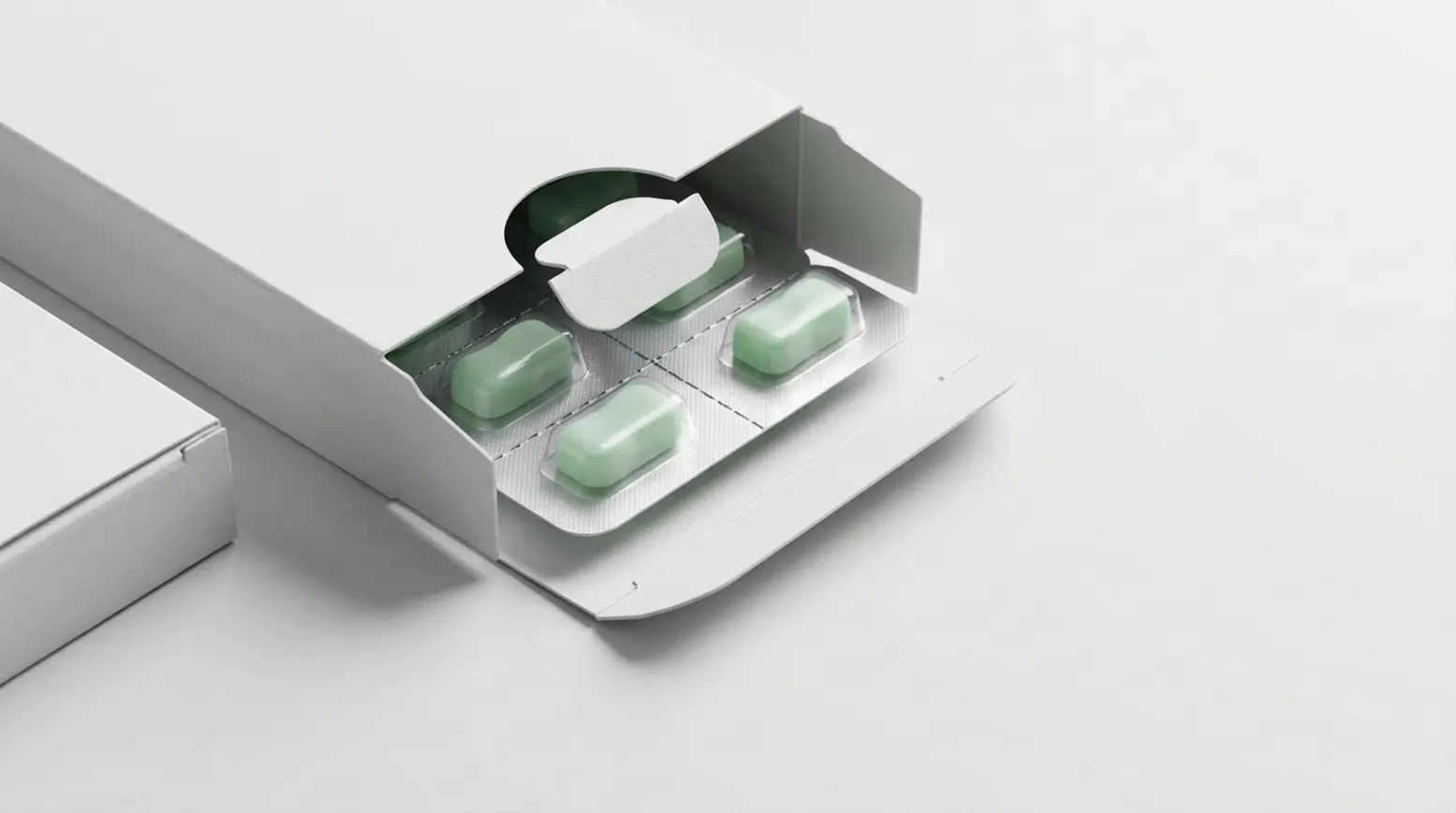

For blistered gummies and similar solid units, the most effective solution is often a certified carton wrapped around the blister. In this setup, the blister keeps each piece separate and sealed until use, while the carton provides the child-resistant opening feature. Because these are two distinct packaging functions, child-resistant packaging for cannabis edibles typically works best when access control remains with the outer carton and product protection is handled by the primary blister.
• A standard blister is not automatically child-resistant, as only a tested design can legitimately make that claim.
• A child-resistant carton can be integrated around an existing blister, meaning teams may not need to redesign their primary pack solely to control access.
• Moisture control, light protection, seal strength, and product stability still fall under the primary blister specification.
• State regulations often require more than just child resistance, including specific rules for opacity, warnings, symbols, tamper evidence, and serving details.
• Reviewing a physical sample helps engineering, regulatory, and procurement teams verify the actual fit and opening performance prior to approval.
Why child-resistant packaging for cannabis edibles matters for blistered solid units
Cannabis edibles packaging requires special care because these products can easily resemble ordinary food. This creates a significant safety concern, particularly for young children. For this reason, packaging teams must plan access control early in the process, alongside considerations for adult usability and overall edible packaging safety. Simply put, child-resistant packaging is designed to be difficult for young children to open while remaining accessible to adults. It is not meant to be impossible to open, and it should still function smoothly for older users. This article focuses specifically on solid edible forms that fit into blister cavities, such as cannabis gummy packaging and similar unit formats. It does not cover jars, pouches, or loose confectionery.
How child-resistant packaging for cannabis edibles addresses a different job than unit separation
A blister pack does one job exceptionally well. It separates each unit into its own cavity, ensuring that unopened pieces remain sealed even after one cavity has been accessed. This supports stock control, unit identification, and a much cleaner format for unit-dose cannabis packaging. Consequently, an edible blister packaging format can limit exposure to the remaining product when compared to a jar or pouch, where the entire contents become accessible once the main closure is opened. For readers seeking more technical background, our child-resistant blister packaging guide explains this division between unit separation and access control in greater detail.
A standard blister does not inherently guarantee child resistance. A package can only be labeled as child-resistant once that exact design has been rigorously tested and certified. Furthermore, a blister does not inherently ensure safe consumption or proper usage; it is simply a packaging format that provides clear physical separation. Therefore, child-resistant packaging for cannabis edibles should be planned as a comprehensive system where the blister protects and separates the product, while the outer carton controls access.
For many blistered edible formats, the child-resistant mechanism can be integrated directly into the carton surrounding the blister. Our child-resistant carton for a blistered edible is specifically designed for this purpose. The blister remains the primary product package, and the carton introduces a controlled opening method. This is often a highly practical cannabis blister carton solution, as it keeps each packaging role distinctly clear and reduces the need for unnecessary modifications to the primary blister format.
How child-resistant packaging for cannabis edibles fits into edible packaging compliance
Child resistance is only one aspect of edible packaging compliance. Depending on the market, THC edible packaging requirements may also dictate opacity, warnings, symbols, serving information, tamper evidence, and regulations for multi-use packs. These points must be reviewed as distinct compliance questions since the way a carton opens will not address every state requirement. California serves as a prime example, possessing clear rules regarding product visibility and multiple-use child-resistant edible packaging, unless an explicit single-serving exemption applies. Nevertheless, these details are state-specific and should not be treated as national standards.
Certification applies strictly to the tested design. Our certified child-resistant pack design page outlines the standards used for our formats across the United States and Europe. If key elements of a design change, retesting may become necessary. Consequently, the final commercial package must exactly match the tested configuration and align with the customer’s regulatory strategy. This is crucial for cannabis unit-dose packaging projects, as even a minor design modification can significantly impact both compliance and supply chain decisions.
When child-resistant packaging for cannabis edibles depends on primary blister validation
The outer carton does not replace the technical engineering required for the primary blister. Packaging engineers still must evaluate cavity shape, forming materials, lidding choices, seal integrity, and stability tailored to the exact edible formulation. Since gummies and similar products can be soft, sticky, and sensitive to environmental conditions, the blister must be fully validated for the actual product. In this way, any child-resistant gummies project remains grounded in concrete product facts rather than general assumptions.
Barrier properties and stability should remain central to the primary pack specification. The carton cannot solve issues related to moisture control, light protection, seal performance, or formulation stability. These are strictly primary blister considerations and should be kept separate to ensure all packaging claims remain accurate. This point is especially important in cannabis edibles packaging, as teams sometimes attempt to solve too many problems using a single packaging layer. A far more effective approach is to maintain product protection within the blister and assign access control to the certified carton.
Pack count also requires careful consideration. A fixed blister count supports unit identification and physical inventory control, making it an excellent fit for many unit-dose cannabis packaging strategies. However, the specific count and layout must strictly adhere to the destination market’s serving and labeling regulations. Ultimately, the package format should facilitate compliance and handling, but it should never be presented as official consumption guidance.
Using child-resistant packaging for cannabis edibles on standard equipment
Once technical fit and compliance are established, most teams naturally ask how the format will perform during production. We support running the carton on standard equipment, which includes traditional cartoning and pharmaceutical packaging lines, at normal production speeds. This is highly beneficial for contract packers and operations teams, as they frequently desire more robust child-resistant edible packaging without the hassle of rebuilding an entire line. Naturally, safety and certification must always come first, followed closely by production integration. Ultimately, a package that runs perfectly on the line but fails to meet the required compliance plan remains the wrong choice.
If a project requires broader support, the team behind us at Ecobliss Pharma can help review your wider packaging strategy. This assistance can include aligning the primary and secondary packaging, though any decision regarding the carton must stay strictly tied to the tested design, the precise blister dimensions, and the specific market regulations governing the product.
Supplier checklist for child-resistant edible packaging
Before finalizing any specifications, teams should request clear proof from their cannabis packaging supplier on several key points. Verify certification for the exact secondary design and ask precisely which standards it meets. Ensure you confirm compatible blister dimensions and the allowable fit range. Additionally, ask for specific material details, manufacturing tolerances, opening instructions, and evidence of adult accessibility. Review the change control protocols carefully, as even minor design modifications could trigger the need for new testing or approval work. Finally, request concrete evidence of line integration to ensure that the chosen package performs well under real-world production conditions, rather than just passing a theoretical paper review.
Comparison point: A blister combined with a certified carton keeps each unit securely in its own cavity, allowing unopened pieces to remain perfectly sealed even after one unit is removed. Conversely, a jar or pouch can expose the entire contents the moment the main closure is opened. In either scenario, state labeling requirements and edible packaging compliance will still demand their own dedicated review.
Specification point: While the carton adds vital child resistance, it does not replace the need for primary blister validation regarding seal strength, barrier requirements, or product stability. For this reason, all edible blister packaging decisions should be collaboratively reviewed by both engineering and regulatory teams.
Format comparison for blistered edible packs
Blister plus child-resistant carton: This format is best suited for blistered solid units, such as gummies, that fit individually into single cavities. It physically separates the units, keeps all remaining cavities sealed after one is opened, and firmly places access control in the outer carton.
Jar or pouch: Widely recognized as a general packaging format; however, once the main closure is opened, the entire contents are often exposed simultaneously. Because this addresses an entirely different packaging need, it may prove far less precise for a cannabis unit-dose packaging plan.
What to review with a physical sample
Conducting a sample review is one of the quickest ways to determine if a specific format works in practice. Engineering teams can use samples to verify blister fit and carton movement, while regulatory teams can properly assess the instructions and opening logic. Meanwhile, procurement teams can confirm whether the format aligns with the intended specifications and supply route. Because tactile feel and opening behavior are incredibly difficult to judge from drawings alone, handling physical samples often helps teams make significantly better decisions earlier in the process.
FAQ
Is a blister pack automatically child-resistant? No. A package can only be labeled child-resistant if its specific design has been formally tested.
Can the child-resistant feature sit in the carton instead of the blister? Yes. Under this configuration, the blister retains its role of protecting the product, while the carton serves to control user access.
Does a child-resistant carton solve barrier protection for gummies? No. Moisture control, light protection, seal integrity, and overall stability remain tied strictly to the primary blister specification.
Do all states use the same rules for cannabis edibles packaging? No. While child resistance is a common requirement, other regulations vary significantly by market. These can include specific rules regarding opacity, warnings, symbols, tamper evidence, and required serving information.
Can this format run on standard equipment? Yes. The certified carton format is designed to run on standard cartoning and pharmaceutical packaging lines at normal production speeds.
Request a free sample.
Request a free sample now!


