


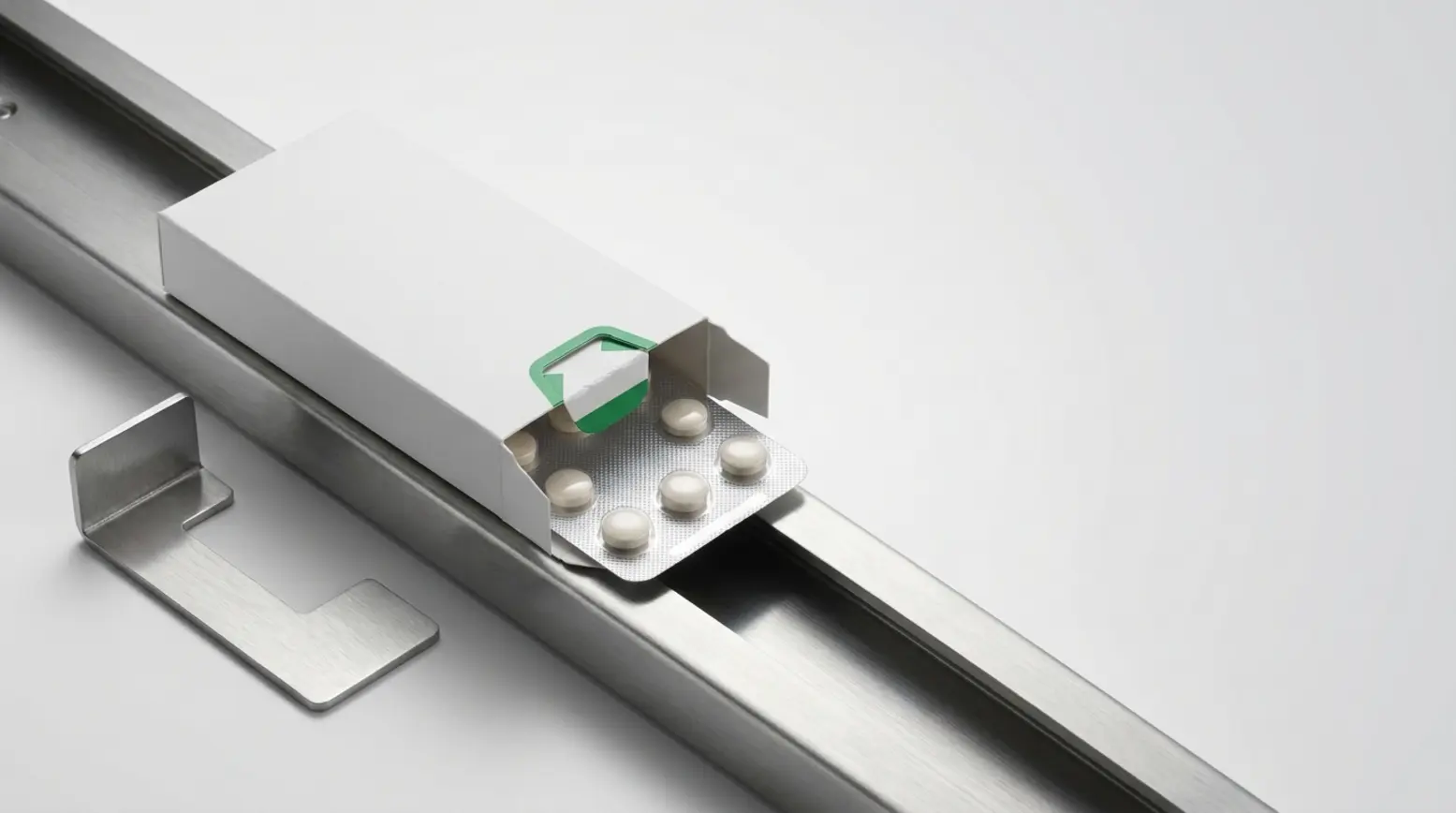

Transitioning to a child-resistant carton does not have to reduce steady production speeds. In most cases, the line can run at a normal output after setup and stabilization, but the transition still requires a controlled format change. This means the initial packaging trial run should cover machine settings, functional checks, operator training, and clear record-keeping, ensuring the new pack becomes a repeatable recipe rather than a special, one-time setup.
• The format can run at normal speeds in steady production once the cartoning setup is correct and the line is stable.
• The first run still requires planned change parts, inspection checks, and approval rules, as this constitutes a real pharmaceutical format change.
• The blister often stays the same if it fits the selected carton design, meaning a blister redesign is not always necessary.
• Quality control should evaluate pack functionality as well as visual quality, since child resistance relies heavily on carton geometry and the condition of the locking area.
• Stable performance is demonstrated across repeat runs through fewer minor stops, reduced manual interventions, and well-documented settings that subsequent shifts can utilize.
Why a changeover to a child-resistant carton should be treated like a controlled format change
A changeover to a child-resistant carton should be managed like any other controlled format change on a cartoner. The line process remains familiar, but the format still requires approved settings, trained operators, and repeatable checks. Our carton is designed so that it runs on standard pharmaceutical packaging equipment; therefore, the primary goal is not to create a special production mode. Instead, the objective is to build a standard machine recipe that production teams can save, repeat, and hand over across shifts.
This matters for packaging changeover times and pharmaceutical line changeover planning, as teams often focus only on the initial hours. A better approach is to prioritize what will support a stable output over time. If the setup is controlled from the start, the first run provides valuable data for future runs, making the format much easier to replicate.
What stays the same on the line
The fundamental cartoning process does not change. The line still feeds the cartons, opens them, inserts the blister, closes the pack, inspects the output, and rejects any packs that fail to meet the standard. If the existing blister fits the chosen design, it can often remain unchanged, meaning no extra child-resistant steps are added to the blister forming process. Teams seeking more background information can review our child-resistant blister packaging guide, which explains how the roles of the blister and the carton differ.
What makes this a format change rather than a special production mode
Because this remains a standard cartoning format change, it should be integrated into recipe control with approved machine settings and standardized workflows. A stable setup should never depend on a single experienced operator remembering minor details. For this reason, setup notes, inspection points, and handover rules must be agreed upon before the first run. By doing so, a cartoner changeover becomes highly repeatable and less risky for subsequent batches.
What a changeover to a child-resistant carton can change on the cartoner
The exact scope of work depends on the machine, the current carton, and the change parts that are already available. During a changeover to a child-resistant carton, teams typically review magazine guides, product guides, pushers, carton transport settings, and closing tools. Some lines also require adjustments to insertion timing or pack support during transfer, as even a minor shift in handling can impact how the carton functions later. For this reason, it is far better to plan a controlled packaging trial run rather than promising a fixed duration too early in the process.
A simple process example is helpful here. One team might find that carton feeding is stable, but the insertion is slightly off, requiring adjustments to the pusher timing and guide positions. Another team might observe smooth insertion, but find that the closure tool presses too tightly, meaning the locking area needs greater protection. These are standard signs of a cartoning setup being carefully refined, and they do not automatically guarantee a long-term loss of speed.
Common machine areas to review
Start by evaluating feeding stability from the carton magazine through to pick-up. Next, review the guides and format parts that control the pack during transport and insertion. Pushers and product guides may need slight adjustments so that the blister enters cleanly and remains perfectly aligned. Closing tools also require careful inspection, as they must form the carton correctly without crushing any critical functional areas. This represents a practical application of SMED (Single-Minute Exchange of Die) principles in packaging, since preparing outside of machine downtime significantly reduces wasted production hours during the actual changeover.
Inspection and support systems to review
Following the mechanical setup, all inspection systems must be thoroughly rechecked. This typically includes code readers, cameras, sensors, leaflet handling mechanisms, and print position checks. Even a minor shift in carton positioning can alter a camera's field of view or read point, meaning that saving the updated inspection settings should be a mandatory part of the approval process. On many lines, this support work is just as vital as the mechanical adjustments; after all, a perfectly formed pack will still fail if the inspection recipe no longer matches its new position.
What a changeover to a child-resistant carton means for carton function checks
A changeover to a child-resistant carton introduces one crucial quality requirement: the pack must still function exactly as designed after passing through the machine. Because the locking mechanism relies heavily on carton geometry, factors like tray insertion, crease quality, press points, and final closure all require careful protection. To better understand why these specific areas matter, teams can review the child-resistant carton mechanism before beginning their first trial. Doing so helps both production and quality teams distinguish between purely cosmetic features and critical functional elements.
Visual quality alone is simply not enough. A carton might look perfectly acceptable on the outside but still suffer from a damaged locking area or poor opening functionality. Therefore, any line handling this format requires dedicated functional tests in addition to standard visual and dimensional checks.
Functional areas that require protection
The primary areas requiring protection are the press points, crease quality, tray insertion alignment, and closure integrity. Press points must remain visible and fully operable. Creases need to stay crisp and clean, as poor crease quality can fundamentally alter how the pack opens and closes. Additionally, tray insertion must stay perfectly aligned so the tray and the carton interact exactly as intended. Finally, the closure must be flawless at discharge, since a poor closure can often mask deeper handling problems further upstream.
Checks to add to standard quality control
The quality control team should introduce functional checks to confirm that the pack opens correctly and that the locking areas are not crushed, folded, or otherwise obscured. These evaluations should complement standard visual and dimensional checks rather than replace them. Furthermore, rejection criteria must be clearly defined before the line even starts. This clarifies operator decisions during the initial run, empowering the team to respond much faster whenever a defect appears. Whether for a contract packer or an internal production site, this level of proactive control greatly supports packaging line stabilization, as recurring issues can be accurately tracked across repeat runs.
How to plan the changeover to a child-resistant carton for the first trial run
A changeover to a child-resistant carton should always be planned before the machine actually stops. This proactive approach saves valuable time and yields far better trial data. In advance, the team should prepare all change parts, draft the initial machine settings, gather trial materials, define inspection criteria, and designate key decision-makers. This is a highly practical way to manage packaging changeover times, as delays frequently occur when simple items are missing or instructions remain unclear.
It is also helpful to separate parameters that can be tweaked during setup from critical defects that require immediate rejection. If the team agrees on these boundaries before the line stops, the first run becomes significantly easier to control. This structured approach supports both SMED packaging principles and a much more reliable pharmaceutical format change process.
What to prepare before the line stops
Begin by preparing and clearly labeling all required format parts. Gather the initial machine settings, keeping in mind that they may need adjustment later. Verify that cartons, blisters, leaflets, coding materials, and inspection tools are all available in sufficient quantities for both setup and verification. Quality, production, engineering, and line leadership teams should collectively agree on inspection criteria, approval limits, and who holds the authority to release the next step. Additionally, a brief pre-trial review can confirm whether any known machine constraints or line speed expectations need to be adjusted prior to starting.
• Machine setup: Confirm the status of all guides, pushers, transport settings, closing tools, and drafted inspection recipes.
• Trial material: Ensure an adequate supply of cartons, blisters, leaflets, coding supplies, and samples specifically designated for destructive and functional testing.
• Team roles: Clearly define who will adjust the machine settings, who will record the findings, and who is responsible for approving the first stable setup.
What to monitor during the initial production period
The initial production period often reveals precisely where the pack is most sensitive on the line. Teams might notice an increase in minor stops, a need for more frequent manual interventions, or require small tweaks to insertion timing and closure settings. A live packaging trial run typically teaches operations much more than a static machine setup ever could, as real-world production demonstrates how the format behaves continuously over time. This learning curve is a natural part of line familiarization and does not imply a built-in, permanent speed penalty.
Carefully track what was changed and what ultimately resolved any issues. For example, if a minor guide adjustment successfully reduces misfeeds, record that data. If camera positions require refinement due to a slight shift in carton orientation, save that update alongside the newly approved recipe. Capturing these essential details helps ensure that future runs start much closer to a fully stable condition.
How a changeover to a child-resistant carton becomes stable across repeat runs
Stable output is proven across multiple repeat runs, not just by producing the first few acceptable packs. A line reaches maturity when reject rates become highly predictable, minor stops decrease significantly, and operators no longer need to apply frequent manual corrections. This is exactly where operator training and focused packaging line work become critical; a well-designed format can still perform poorly if the team does not know what specific issues to watch for.
Accurate documentation matters just as much as precise machine adjustments. When the initial stable settings are clearly saved and recorded, subsequent shifts can replicate the exact same cartoning setup with far less uncertainty. This seamless handover strongly supports packaging line stabilization and makes future production planning much more realistic.
Key training points for operators
Operators must clearly understand which carton features are purely functional and which are merely cosmetic. Show them exactly what a damaged locking area looks like, demonstrate the visual signs of poor crease quality, explain how a misfeed typically appears, and highlight what an incorrect closure looks like at discharge. It is also incredibly helpful to demonstrate the correct opening method, as this makes the intended pack functionality much easier to grasp. Armed with this knowledge, operators will find that defect recognition becomes vastly faster and more consistent during routine production.
Documentation that supports true repeatability
Thoroughly document all approved settings, setup notes, inspection records, comparisons between repeat runs, and any specific changes made during the stabilization phase. Quality records should comprehensively include functional checks, reject counts, instances of damaged packs, minor stops, and manual interventions. Capturing this data creates a much stronger production history, proving that the line is manufacturing the intended design in a highly controlled manner. For broader context, our page regarding certified child-resistant packaging explains the vital difference between a formally tested pack design and daily production controls. Ultimately, certification applies strictly to the specific design that was tested, whereas production records demonstrate that the line is manufacturing that exact same design consistently. If the underlying design geometry changes, formal retesting may be required. However, if machine settings are simply optimized without altering the core design, that remains an internal production control matter.
Questions operations teams often ask before a first trial
Does a child-resistant carton always slow the line down?
No. The ultimate target is to maintain normal running speeds during steady production once setup and stabilization are complete. Naturally, the first run may require some extra attention as the team learns the nuances of a new format and confirms the machine settings. However, that brief learning period is entirely different from a permanent loss of operational speed.
Do we need to redesign the blister?
Not always. If your existing blister fits seamlessly into the selected design, it can remain entirely unchanged. In many instances, the bulk of the required work lies in optimizing the outer carton setup and the inspection recipes, rather than modifying the blister forming process.
Can we establish a fixed duration for the changeover in advance?
No, because the exact duration depends heavily on the specific machine, the current format, the availability of change parts, necessary inspection updates, and the team's overall familiarity with the new setup. It is always safer to plan the work in a controlled, step-by-step manner rather than promising a fixed timeframe too early in the process.
What should the quality team record during the first runs?
The quality team should meticulously record the results of functional checks, visual and dimensional evaluations, reject counts, minor stops, instances of damaged packs, manual interventions, and the exact settings used to achieve stable output. Comparing data across repeat runs is also highly beneficial, as it clearly highlights whether the line's performance is improving in a truly repeatable way.
When should we ask for technical input?
You should request technical input well before the trial begins if there are any lingering questions regarding pack fit, machine limitations, trial materials, or functional testing requirements. Securing early support can easily prevent avoidable delays during setup and helps establish highly realistic approval criteria long before the production line actually stops.
Practical next steps for your team
If you are currently planning a first run, focus on keeping the process as simple and controlled as possible. Clearly define the format parts, initial settings, inspection points, required quality records, and specific approval roles well before the planned downtime begins. If your team would like to review trial materials, machine limits, or format requirements in advance, please contact us about your first trial, and we will gladly discuss the practical details with you.
Whenever broader packaging support is needed, the group behind us is fully equipped to assist through Ecobliss Pharma. Our comprehensive services can include specialized design support, packing operations, component production, track-and-trace coding integration, and even supplying advanced packaging machinery when those topics fall within your wider project scope.
Want Ecobliss to pack your product into Locked4Kids cartons, including serialization? Ecobliss Pharma handles quotes and contract packing: request a quote from Ecobliss Pharma.
Request a free sample now!


