


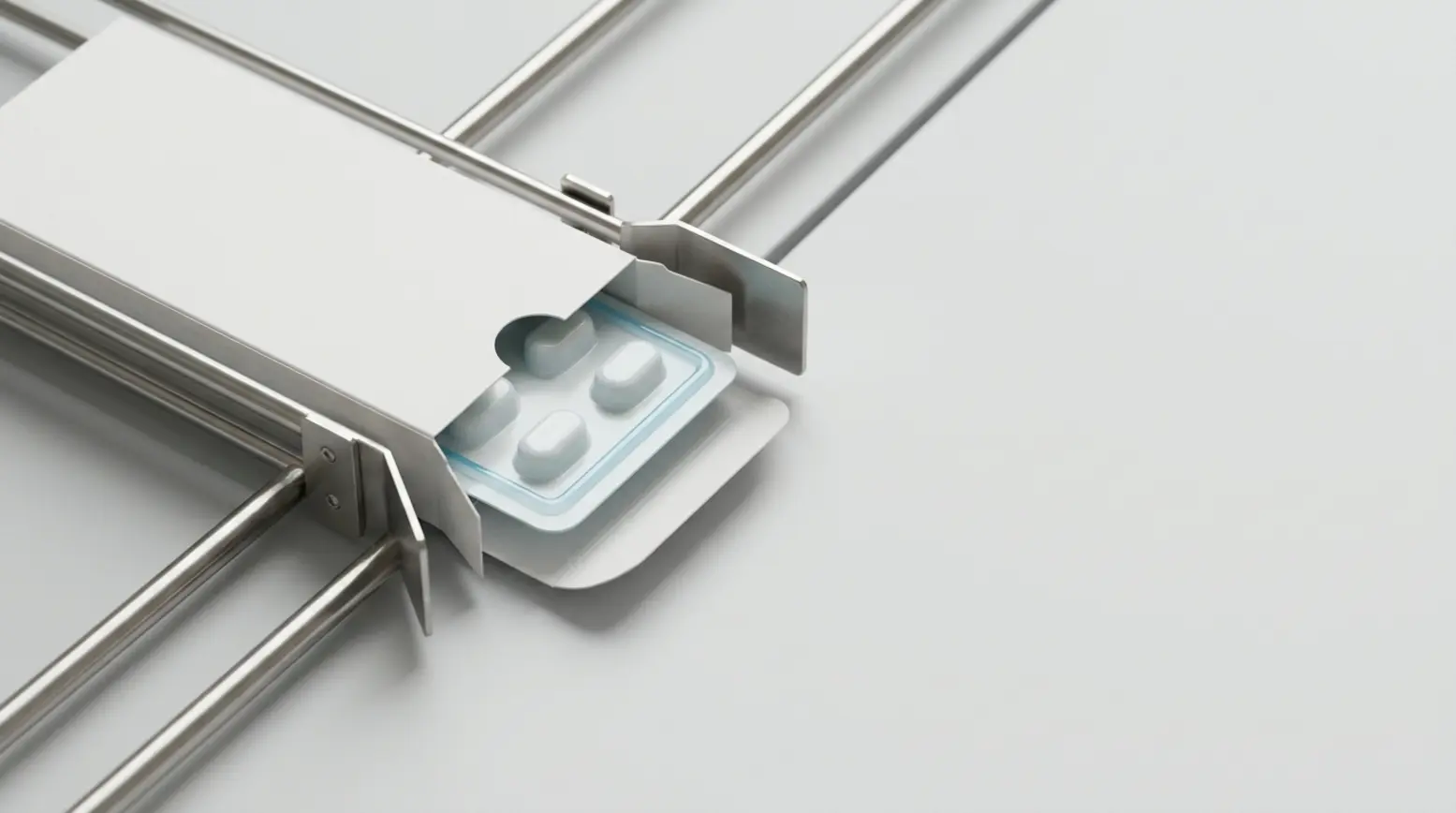

While a child-resistant carton may run on standard pharmaceutical equipment, successful operation is never automatic. Cartoner compatibility for CR cartons always requires a thorough review on a specific machine with a designated format, board grade, and product setup. Feeding, opening, tray insertion, closing, inspection, and reject control can all alter the outcome, even when outer carton dimensions appear identical.
• Outer dimensions alone do not guarantee machine suitability, as functional carton areas may still be engaged incorrectly.
• Start by reviewing the carton drawing, board grade, tray layout, and product setup before discussing tooling or trials.
• Check the machine path step by step: magazine, pick-up, opening, transfer, insertion, closing, inspection, and rejection.
• Record the results in a simple compatibility file so the team knows what is approved, what requires a trial, and what may necessitate new parts.
• Any machine-driven design changes should be reviewed against the certified pack design before final approval.
Cartoner compatibility for CR cartons starts with the carton, not the machine
Our review starts with the actual pack design because cartoner compatibility depends on much more than carton width, length, and height. A child-resistant carton with a tray features functional areas that support its child-resistant performance. A machine might accommodate the outer dimensions but still be unsuitable for the format. This is why a packaging machine assessment must begin with the controlled drawing, tray layout, product count, leaflet setup, and board specifications.
This approach also helps the team avoid false comparisons. A cartoner that runs a similar pharmaceutical carton may still exhibit poor compatibility with a child-resistant format. Pick-up points, the opening motion, or the closing system might act on sensitive areas of the carton. By checking these details, the project starts from facts rather than assumptions.
Why cartoner compatibility for CR cartons requires a machine-specific assessment
We design these packs for standard pharmaceutical lines, and you can read more about formats that run on standard pharmaceutical equipment in a broader production context. Even so, each line still requires a machine-specific assessment because cartoning specifications differ significantly from one model to another. Magazine shape, suction methods, opening stations, transport chains, insertion paths, closing tooling, and vision setups can all alter how the pack behaves.
A useful compatibility review should produce a concise document outlining key points: machine identity, configured format range, carton and product dimensions, board requirements, closing method, packaging machine format parts, cartoner change parts, open risks, trial conditions, and ownership. This gives procurement, engineering, operations, and suppliers a single shared reference. Consequently, teams can decide earlier whether the format fits the line, requires trials, or needs changes before proceeding to quotation and tooling.
How cartoner compatibility for CR cartons should be checked at the magazine and feeding stage
Check carton magazine specifications first
The first machine area to review is the magazine. Poor feeding can halt the entire project long before insertion or closing is even tested. Check the flat blank size that the machine accepts, the adjustment range at the planned line speed, and the actual feed consistency. Carton magazine specifications are crucial because two machines with similar size capabilities may still separate and transfer blanks in entirely different ways.
Observe how the blank is picked, how it is separated from the stack, and how stable the handoff remains during a normal run. If the planned format sits close to a machine limit, slight variations in coating, humidity, or board friction can cause double picks, missed picks, or unstable transfers. These issues must be identified early so the team avoids ordering parts before the feed path is fully proven.
Review board range, thickness, and stiffness
Board thickness matters, but stiffness is equally important, as both impact opening, transport, and closure quality. A machine check of the carton caliper should compare the equipment's allowable board range against the controlled carton material. If the board is too soft, the blank may not open squarely. Conversely, if it is too stiff, rails and folders may stress the folds or pressure zones that support the pack's functionality.
This is where relying on past project memory can create risk. Teams sometimes assume a previous carton looked similar enough, but a minor change in caliper, coating, or grain behavior can drastically alter the results. Therefore, a fresh material check is a vital part of assessing cartoner compatibility.
Confirm pick-up geometry and guide contact points
Check exactly where suction cups, guides, rails, lugs, and transfer parts touch the blank. The goal is simple: understand which machine parts contact the carton, when they make contact, and how much adjustment is available. While a standard carton may tolerate broad contact, a child-resistant format often features highly sensitive zones, meaning all contact points must be carefully reviewed against the drawing.
If a guide or suction point acts on the wrong panel, it can impair the opening action or compromise the final lock geometry later in the process. This is one of the most practical aspects of a pharmaceutical cartoner setup review, as it translates a general machine capability claim into a factual check for a specific format.
How cartoner compatibility for CR cartons affects erecting, transfer, and insertion
Review the carton opening and transfer path
The carton must open squarely and remain stable throughout the transfer. If it twists during erecting, subsequent stations will lose control, which can negatively affect folds, press areas, or final alignment. Opening quality must therefore be a core part of the trial acceptance criteria, rather than a mere side note.
Additionally, review the path into pockets, chains, or carriers. Check whether side guides or transport parts press against any functionally sensitive areas. A machine may technically be able to run the carton, but poor handling paths can still degrade the final pack quality. This is exactly why cartoner compatibility for CR cartons must evaluate the complete route through the line, not just the initial feeding stage.
Check tray and product insertion in detail
Our format utilizes a tray for blister strips, making insertion a step that must be checked meticulously. Review the insertion path, pusher design, timing, clearances, tray alignment, leaflet interaction, and push force. If you want more background before conducting this machine review, you can read our guide to child-resistant blister packaging for context regarding blister and tray integration.
Push force is a critical metric. Excessive force can stress the carton walls or shift the tray out of position, while poor control can allow the tray to enter at a skewed angle. This step typically links the product count, leaflet, tray, and machine setup into a single trial condition. Consequently, it should be planned collaboratively by the machine builder, the packaging supplier, and the customer.
How cartoner compatibility for CR cartons depends on closing, inspection, and rejection
Confirm the cartoner closing system
The pack must perfectly match the specific way the machine executes the closure. Determine whether the line uses a tuck, glue, or another established method, and then verify the rails, flap folders, compression belts, and glue positions where applicable. The cartoner closing system is vital because a pack can look acceptable at first glance but still suffer from weak functionality if the closing geometry is slightly off.
If the machine team proposes a minor design adjustment to improve closure, that modification must be thoroughly reviewed before becoming a final tooling instruction. In this way, closure approval covers both appearance and functional integrity, which is essential for any controlled child-resistant design.
Include sensors, cameras, and reject logic
Inspection is a fundamental part of compatibility, so evaluate the current sensors and cameras with the final pack position in mind. Opening instructions, press-point graphics, codes, and presence checks must remain visible exactly where the line expects to scan them. While vision systems can confirm print locations, product presence, or closure positions, they cannot prove child resistance on their own.
Reject logic matters just as much. The line must reliably remove packs that exhibit failed openings, poor closures, missing products, or other defined faults. If the machine cannot reject these specific failures in a controlled manner, the format may still require changes, even if it appears to run smoothly.
The format parts check that should happen before quotation
Before requesting a final quotation, identify all packaging machine format parts that are specific to this carton. This can include guides, pockets, carriers, pushers, flap folders, and closing tools. Once identified, confirm which parts are adjustable and which require entirely new cartoner change parts. This step separates one-time engineering costs from unit pack costs, making the overall project much easier to plan.
Ownership should also be established clearly from the start. The team must know who designs the parts, who supplies them, who qualifies them, and who provides the final sign-off. Creating a brief responsibility matrix prevents later delays, ensuring every party understands their role long before tooling begins.
Questions to ask before tooling is ordered
Use the questions below as a simple project control tool. They help minimize back-and-forth communication by clearly splitting the discussion between the machine builder and the packaging supplier.
• Machine builder: What carton size limits apply to this exact machine and configured format? What board range is accepted? How does the magazine handle this specific blank? Which parts are adjustable, and which new parts are needed? What closure options are possible, where are sensors and cameras positioned, and what trial conditions do you recommend?
• Packaging supplier: What is the controlled carton drawing? What is the material specification, and what tray setup is used for the blister strips? Which areas are functionally sensitive? What tooling limits apply, and what changes could potentially affect the approved design boundary?
• Required compatibility output: The document should state the named machine, actual format, board grade, product setup, closure method, planned speed, trial conditions, required parts, open risks, responsibility split, and final decision status.
Certification boundaries and what cannot change without review
Our pack designs are certified to ISO 8317 and F=1 standards, but the certification belongs to the design itself. You can read more about this on our certified child-resistant packaging page. While a machine trial can demonstrate that a format runs efficiently, this is vastly different from confirming that the controlled design remains uncompromised.
If machine-driven changes affect dimensions, locking geometry, press areas, or any other critical feature, the design may require a formal review and possibly further testing. This critical detail is easy to overlook when a team is rushing to solve a line issue. Therefore, any proposed modification should be rigorously checked against the approved design before it becomes part of the final pack specification.
Send your machine and format details for review
If you are planning a new project or reviewing an existing line, please send us your actual machine and format details first. Include the machine type, configured format range, carton drawing, board grade, tray and product setup, leaflet details, closing method, and any known limits regarding feeding, insertion, or closure. We can then review the practical risks with you and define what still needs testing. Feel free to contact us for a compatibility review whenever you are ready.
If you require broader support for your packaging project, the group behind us can also assist through Ecobliss Pharma. They handle related packaging work, including product-specific design, contract packing, or machinery supply for customers looking to insource. While this wider support is secondary to the compatibility review, it can be highly beneficial when the project scope begins to expand.
FAQ
Can a machine that runs a similar carton also run a CR carton?
No. A similar outer size does not guarantee full compatibility. The machine still needs to properly handle the actual board, pick-up points, opening path, tray insertion, and final closure geometry for that specific format.
What part of the machine should we check first?
Always start with the magazine and feeding system. Feeding problems typically emerge before any other issues, making this the fastest place to confirm whether the format falls within the practical capabilities of the machine.
Do sensors confirm child resistance?
No. Sensors and cameras can inspect print quality, product presence, and closure positions, but they cannot prove child-resistant performance. That performance is strictly tied to the certified pack design.
When do format changes affect certification?
Changes can impact certification whenever they alter dimensions, locking geometry, press areas, or other functional features. Consequently, machine-driven changes should always be carefully reviewed before being released for tooling or production.
What should a compatibility review deliver?
It should yield a concise written document detailing the machine name, configured format, product setup, board specification, closure method, required change parts, trial conditions, open risks, responsibilities, and approval status. This provides the team with a clear, factual basis for the next phase of the project.
Want Ecobliss to pack your product into Locked4Kids cartons, including serialization? Ecobliss Pharma handles quotes and contract packing: request a quote from Ecobliss Pharma.
Request a free sample now!


