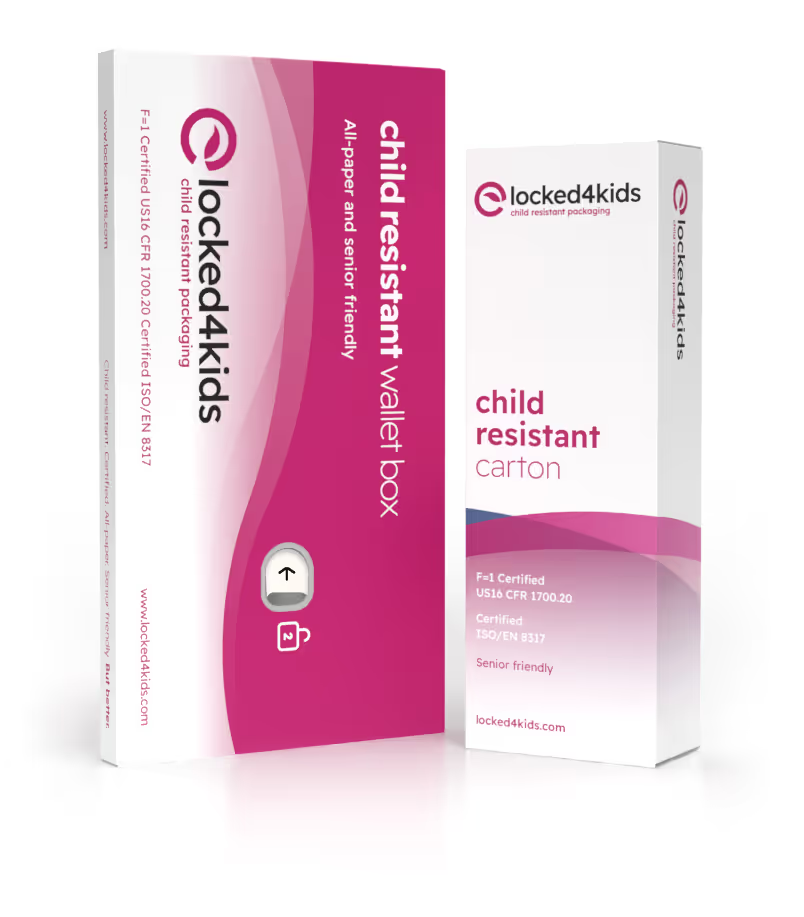
Locked4Kids specializes in child-resistant packaging that adheres to stringent CPSC regulations and ISO standards, like 16 CFR 1700.20 and ISO 8317. These certifications ensure compliance with the Poison Prevention Packaging Act (PPPA), guaranteeing that our packaging solutions are both senior-friendly (CRSF) and highly resistant to tampering by children. Our packaging meets the highest standards of safety for hazardous substances, making it ideal for sectors like pharmaceuticals.
ISO 8317 is the European standard for reclosable child resistant packaging. 16 CFR 1700.20 is the US test method under the Poison Prevention Packaging Act, enforced by the CPSC. They are separate routes: one certificate does not cover both markets.
The Locked4Kids carton and Wallet Box are certified to both. The certification covers the carton and the Wallet Box.
F=1 means that access to a single unit counts as a failure in the US child test. It does not mean that 1% of children opened the pack. For blister packs it is the strictest setting. Both Locked4Kids formats are certified to 16 CFR 1700.20 under protocol F=1.
To meet certification standards, Locked4Kids packaging underwent rigorous testing at an ISO 17025-accredited lab.
Step-by-step certification process:
1. Initial testing: Packaging is first tested with children using industry-standard protocols.
2. Senior testing: The packaging is evaluated for ease of use with adults, ensuring at least 90% accessibility.
3. Certification: Upon meeting the stringent requirements set by 16 CFR 1700 and ISO 8317, the packaging is certified as both child-resistant and senior-friendly.
Testing involved real-world conditions to stimulate potential hazards. Children from nursery schools and playgrounds were allowed to use any means to open the packaging. They had two rounds of 5 minutes each to try and open it, with a demonstration given after the first round. The packaging passed stringent requirements, with less than 1% of children able to open it before demonstration and under 4% afterward.
Children aged 42 to 51 months try to open the pack in two rounds of five minutes, with a demonstration after the first round. Under 16 CFR 1700.20, at least 85% of the children must fail to open the pack before the demonstration, and at least 80% after it. Adults aged 50 to 70 then show that they can open the pack, and at least 90% must succeed.
- Children: 300 children participated, with less than 1% able to open the packaging before the demonstration. After two testing rounds, less than 4% managed to open it, significantly surpassing the safety requirement of 15% and 20% under CFR 1700.20 guidelines.
- Seniors: All seniors tested (100%) successfully opened the packaging, exceeding the regulatory requirement of 90% accessibility for adults.
Under US regulations, only immediate or primary packaging qualifies as child resistant packaging. To qualify, all parts must stay connected after each opening by the consumer. The Locked4Kids carton qualifies as primary packaging under US rules, because all parts stay connected after each opening.
“Locked4Kids' child-resistant packaging has given us complete peace of mind knowing that our products are both compliant and secure, while being easy to open for seniors.”
Further reading
ISO 8317 vs 16 CFR 1700.20: the differences
16 CFR 1700.20 explained: US child resistant test steps and pass rules
F1 protocol child resistant packaging: how to read a passing US test
Last updated: November 2026