


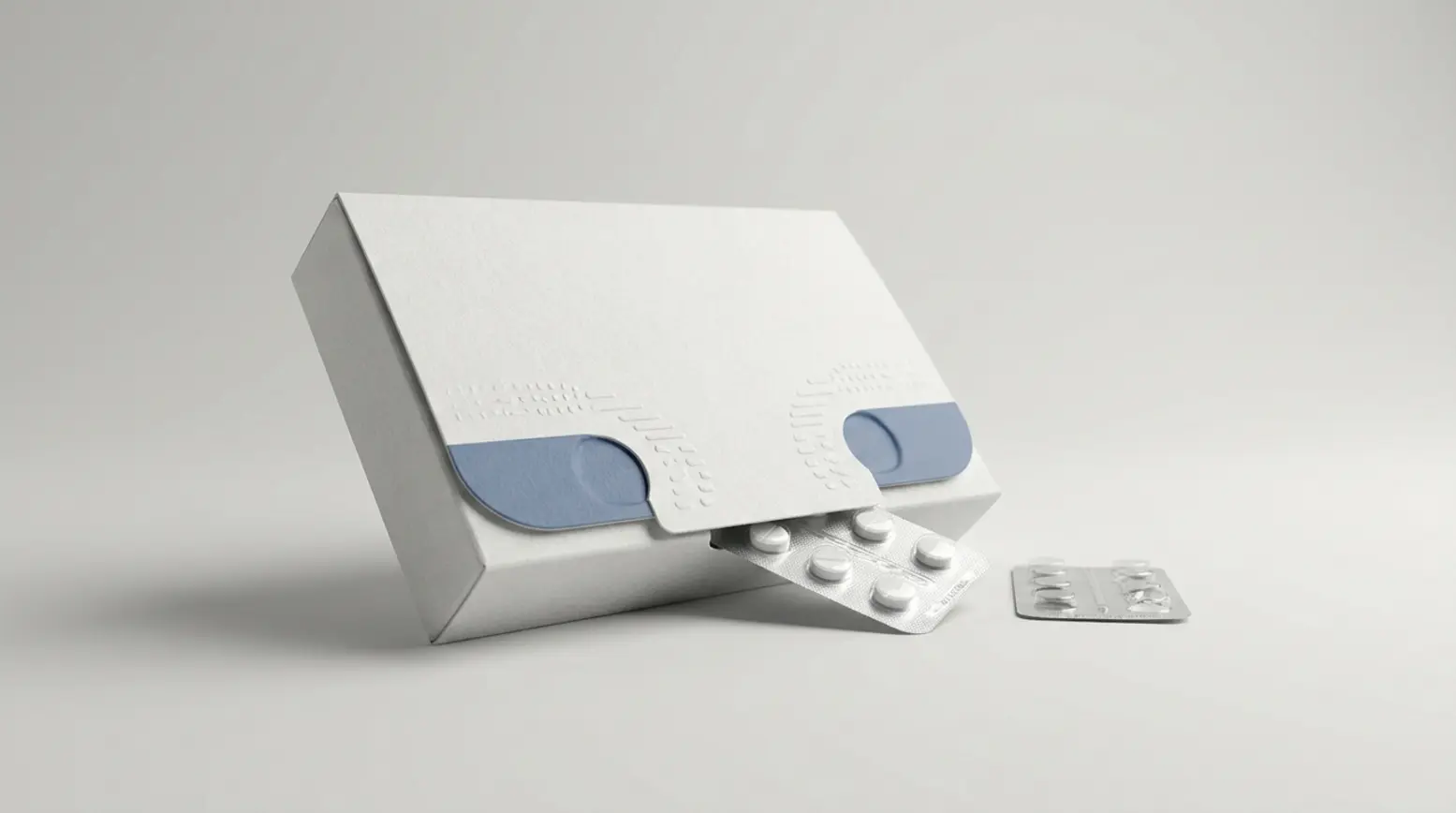

Senior-friendly packs work best when teams turn usability into clear design rules. Senior-friendly packaging design rules help older adults open a package with reasonable effort, clear hand positions, and easy-to-see action points, all while child-resistance remains strong. This means the packaging should guide the user through simple steps, avoid tiny features, reduce awkward force, and be tested with the intended adult users before formal certification.
• Senior-friendly performance comes from physical design choices that people can see, feel, and test.
• Child-resistance and adult usability must work together in a single mechanism.
• Grip strength, pinch control, joint movement, touch, and vision should be evaluated as separate design factors.
• First-time opening and repeat opening should be tested separately, as daily use matters long after the initial success.
• The most useful next step is to physically assess the mechanism with a free sample.
Why senior-friendly packaging design rules start with testable design choices
Senior-friendly packaging design rules should start with features that teams can readily observe and compare. A package is truly senior-friendly when the intended adult users can open it using clear actions and reasonable effort. This is crucial because older adults often experience changes in grip, finger control, joint movement, touch, and vision. If the opening point is hard to locate, the required action is unclear, or too much force is needed, the package creates an immediate barrier. For a broader context, it helps to explore the basics of senior-friendly packaging before returning to the rule set in this article, as practical design choices are exactly what teams can test early on.
Of course, safety must remain a priority. A package only works well when adult access improves without compromising child protection. Therefore, any modification designed to make opening easier should be carefully evaluated against the standards of child-resistant packaging. In this way, senior-friendly packaging design stays grounded in real performance rather than broad claims.
What senior-friendly should mean in practice
In practice, it should mean measurable adult usability. The intended users must be able to locate the action point, understand the required steps, and complete the opening sequence in a reliable, repeatable manner. Shape, texture, print, and component placement all matter, as they provide vital user cues before any physical force is applied. Consequently, accessible packaging design must be evaluated in the hand, not just on a screen or in a meeting room.
Why safety still has to stay in place
If a package becomes too easy to open in the wrong way, its child-resistant function may weaken. Because of this, packaging for older adults cannot be improved merely by removing resistance. The mechanism must require the correct adult action, ensuring that age-friendly packaging remains usable while still effectively controlling child access.
Senior-friendly packaging design rules for grip, finger control, and strength
Older adults are not a monolithic group with a single ability level, so design teams should avoid relying on a fixed idea of easy-open packaging that elderly users will universally prefer. A far better approach is to separate strength, finger control, and hand stability into distinct categories. Senior-friendly packaging design rules become significantly more useful when each factor is tested individually, as this makes design adjustments easier to compare and improve.
Lower grip strength
Accommodating lower grip strength means the opening mechanism should rely on reduced effort and better contact surfaces. Wide press areas, stable support points, and actions that do not depend on forceful squeezing are typically very helpful. Therefore, senior-accessible packaging should allow the user to apply force in a controlled manner, since precise control is often just as critical as raw strength.
Reduced finger control
Tiny tabs, thin edges, and narrow pinch points can halt the opening sequence before it even begins. A user might understand exactly what to do but still fail to grip the feature securely enough to execute the action. For this reason, senior-friendly packaging design should avoid very small target areas, especially when the mechanism depends heavily on precise finger movements.
Comfortable hand position
Stable hand placement helps users maintain control throughout the entire action. If the wrist bends awkwardly or the hand slips during opening, success rates can plummet. This is particularly important for elderly-friendly medicine packaging and inclusive pharmaceutical packaging, as safe and consistent daily access matters over time, rather than just succeeding on the first attempt.
Senior-friendly packaging design rules for joints, touch, and vision
Many opening failures happen simply because the required movement is awkward, the tactile cues are weak, or the visual guidance is poor. While these issues may seem minor during the development phase, they quickly become glaringly apparent in user testing. Senior-friendly packaging design rules work best when teams review joint mobility, tactile guidance, and eyesight as distinct components of the user experience.
Joint movement and wrist position
Stiff joints can make twisting, bending, and strong wrist rotations incredibly difficult. Recognizing this, accessible packaging design should aim to minimize awkward rotation and keep necessary actions as close to a natural hand position as possible. In many cases, a controlled push or press action is far easier than a forceful twist, allowing the user to open the package with much less physical strain.
Touch cues that users can find easily
Many users naturally explore with their fingers before they even look at printed instructions. Raised zones, contoured edges, and clearly defined action points help the hand navigate to the right spot much faster. This is especially vital when a user's touch sensitivity is diminished, as the package must then rely on distinct tactile cues to guide them effectively.
Visual cues and readable instructions
Age-related changes in vision can significantly affect contrast perception, glare tolerance, and reading comfort. Consequently, opening points should stand out clearly against the rest of the surface, and any printed instructions should be positioned right next to the action area. Plain, direct verbs such as press, hold, and pull are typically much easier to follow than lengthy, complex sentences. This straightforward approach is immensely helpful in packaging designed for older adults, as well as in easy-open blister packaging, where users require immediate and clear visual cues at the precise moment of opening.
Senior-friendly packaging design rules for opening steps and two-handed use
Two-handed use is not inherently problematic. The real question is whether both hands remain comfortable and whether the overall action stays firmly controlled. Senior-friendly packaging design rules should focus on how the functional sequence plays out in everyday practice, given that some two-handed packages are remarkably intuitive, while certain one-handed designs still fail miserably.
When two-handed opening works well
It works beautifully when each hand is assigned a clear role, the package remains stable, and the required force stays comfortably low. The user should never have to overstretch, tightly grip a minuscule area, or physically wrestle with the mechanism. By adopting this balanced approach, senior-friendly packaging can actively support controlled movement without making the user work harder than absolutely necessary.
When two-handed opening becomes difficult
Conversely, problems typically begin when one hand must anchor a small point while the other hand pulls hard or twists sharply. An excessive reach, narrow pinch zones, and simultaneous, combined actions can drastically increase the failure rate. Therefore, age-friendly packaging should seek to eliminate hold-and-pull combinations whenever they demand high physical force or awkward wrist motions.
Use short and plain action steps
A well-designed opening mechanism utilizes highly visible cues, strong tactile markers, and a brief action sequence. Users should immediately understand what to do without resorting to frustrating trial and error. If instructions are genuinely necessary, they should be printed directly at the action point using simple, concise language. This strongly supports senior-accessible packaging by ensuring the user gets critical help at the exact moment they need it.
Senior-friendly packaging design rules for testing before certification
Senior-friendly packaging design rules become most advantageous when teams rigorously test different variants before paying for formal approval and certification work. Early design testing rapidly reveals what helps users, what blocks their progress, and what fundamentally needs to change. Furthermore, this is the ideal stage for aligning engineering, compliance, and procurement teams around hard evidence rather than subjective opinions. If you require more background on formal proof, our resource detailing certified child-resistant packaging perfectly explains why test evidence strictly belongs to the specific design that was assessed.
Test first-time opening and repeat opening separately
Evaluating the first opening indicates whether the mechanism is intuitive the very first time a user encounters it. Conversely, repeat opening demonstrates whether daily use remains manageable once the action is a known quantity. Both stages matter greatly, as medicine and supplement packages are frequently opened time and time again. Consequently, a package can successfully pass the initial encounter but still create enduring usability problems later on.
What to measure in early testing
Development teams should carefully record the time to first opening, the number of failed attempts, whether instructions were needed, and exactly what users attempted before they finally succeeded. While these metrics are straightforward, they are immensely useful because they highlight both functional performance and user confusion. By capturing this data, easy-open packaging that elderly users handle well can be accurately identified through direct comparison instead of mere guesswork.
What not to rely on
Although simulation gloves can highlight physical limitations, they can never truly replace intended adult users. Real users exhibit genuine hesitation, inventive workarounds, and cognitive misunderstandings that a mechanical simulation simply cannot replicate. That is why formative testing must always include the actual demographic the package is designed to serve.
How formal testing differs from design testing
Design testing focuses on refining and improving the package before pursuing regulatory approval. In contrast, formal testing confirms the performance of one strictly specific design under a highly defined methodology. While general frameworks such as ISO 17480 can support strategic thinking around ease of opening and accessible packaging design, final certification always belongs exclusively to the exact package that was formally tested. If the mechanism, structural material, or overall shape changes in any way, entirely new testing may be required.
A practical example using an all-paper wallet box
One highly illustrative example is our all-paper Wallet Box. Its mechanism strategically utilizes simultaneous press points rather than requiring high force, ensuring that the opening action depends more on coordinated movement than raw physical strength. This makes it an excellent, practical example of how senior-friendly packaging design rules can support adult access while the core child-resistant goal stays firmly intact.
The approved senior usability result is very specific and limited: 100 percent of seniors successfully opened the Wallet Box within five minutes. We present this figure exclusively as a validated result for this exact design. It absolutely does not guarantee the same success rate for a different package or even a modified version of this same concept. This distinction is critically important for compliance and procurement teams because certification is design-specific; therefore, evidence for one package should inform design decisions, not replace the mandatory testing required for another version.
Common design mistakes that exclude older adults
Many packages appear perfectly fine during a desk review, yet still fail miserably in real-world use. The culprit is frequently a minor design feature that quietly blocks access. Once engineering teams know exactly what to look for, they can catch these hidden issues much earlier and improve the senior-friendly packaging design long before costly approval work begins.
Small tabs and hidden opening points
Tiny peel tabs, awkwardly narrow corners, and opening points that visually blend into the background graphics can stump a user before the physical action even starts. While the package may still open flawlessly in theory, the practical path to success remains entirely unclear. As a result, frustration rises rapidly, and the user may resort to dangerous or unsafe workarounds.
Stiff tear areas and high twist force
Unforgivingly stiff tear areas and designs requiring immense twisting force can easily alienate users with limited strength or restricted joint movement. This is particularly true when a mechanism demands brute force and pinpoint finger accuracy at the exact same time. A package should ideally function as intended without demanding a perfect grip or an incredibly strong wrist.
Gloss, weak contrast, and late instructions
Bright, glossy reflections can obscure critical opening cues in normal lighting conditions, while poor visual contrast makes printed text and vital action points incredibly difficult to discern. Moreover, instructions that become visible only after a failed attempt are usually too late to assist with that crucial first opening. To prevent this, the design should provide clear guidance much earlier and position it closer to the primary action point.
Questions teams should ask before freezing the design
Can a child-resistant package also be easy for seniors to open?
Yes, provided the mechanism is intelligently built around the correct adult actions. The ultimate goal is controlled access through clear, intuitive movements, minimal confusion, and reasonable physical effort. We consistently see much better results when a design prioritizes a straightforward action sequence instead of relying on high resistance and sheer force.
Does two-handed use always reduce accessibility?
Not at all. Two-handed use can work remarkably well when both hands remain in a comfortable position and the required exertion is kept low. It typically only becomes problematic when one hand is forced to hold a tiny, awkward feature while the other hand must execute a hard pull or a strenuous twist.
When does a design change require new testing?
New formal testing is often necessary whenever a modification alters how the package opens, closes, or actively resists child access. This can include structural changes to materials, the overall physical shape, internal mechanism details, or the mandated user actions. Because compliance certification is rigidly linked to one specific design iteration, any proposed changes must be reviewed with immense care.
How can teams compare design variants fairly?
Development teams should test every variant under the exact same conditions, faithfully recording the same metrics each time. By comparing the time to first opening, total failed attempts, reliance on instructions, and general user behavior prior to success, organizations can provide engineers, compliance officers, and procurement teams with a much clearer, evidence-based foundation for making critical decisions.
If you want more context before the design phase
If you would like a broader view beyond these practical rules, our senior-friendly packaging guide comprehensively explains why this crucial topic matters across the pharmaceutical, cannabis, and nutraceutical industries. We have intentionally kept this current article focused on actionable design choices, as that is exactly where better real-world results begin. Furthermore, if your upcoming project requires wider operational support, the team behind our solutions at Ecobliss Pharma can assist with full-scale packaging development, contract packing services, regulatory code printing, and specialized machinery.
If you prefer to physically assess the opening mechanism for yourself, please feel free to request a complimentary sample from our team.
Request a free sample now!


