


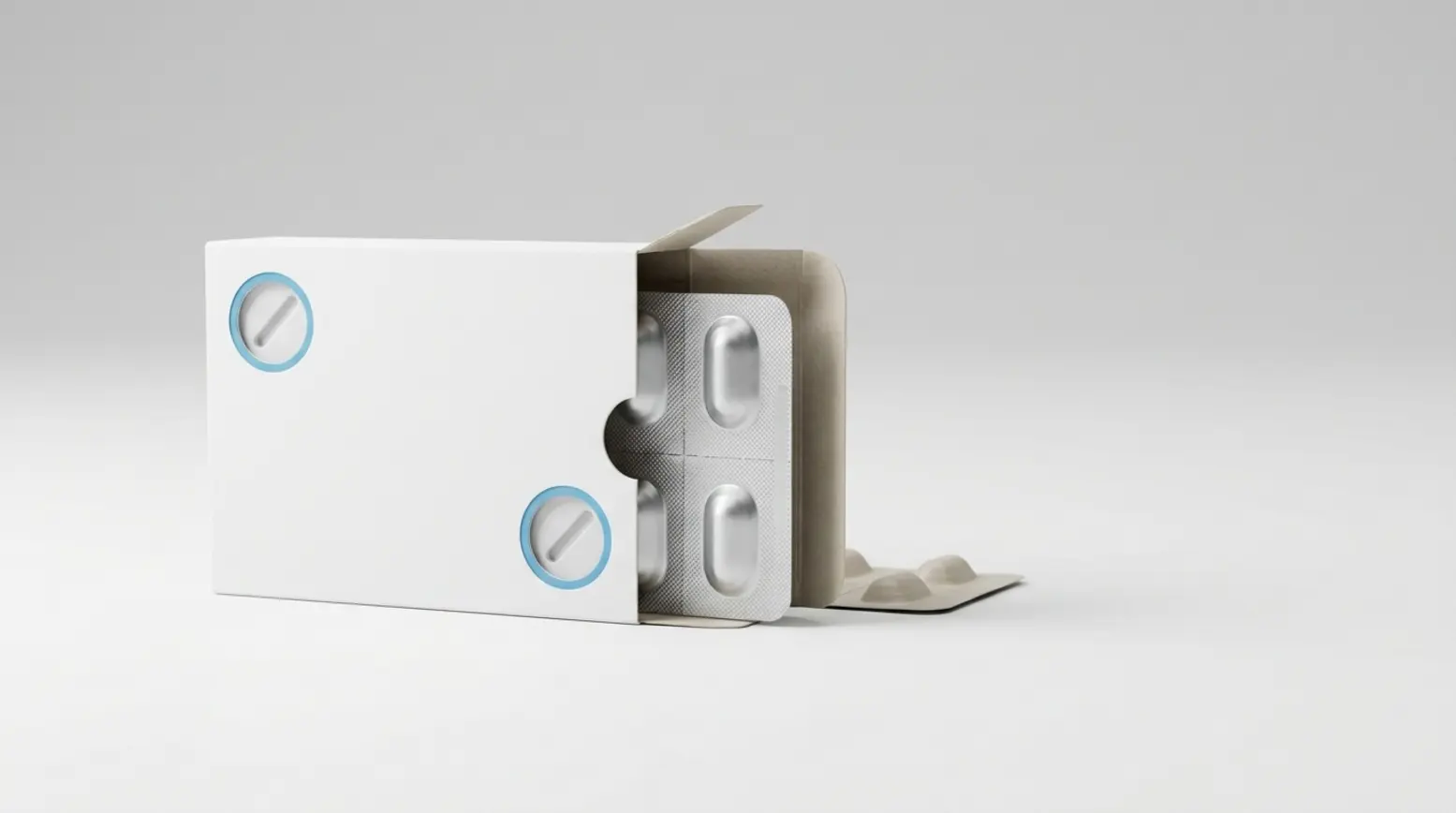

The opening force in medicine packaging matters because adults must be able to open a package safely and without strain. The simple answer is this: there is no single force value that works perfectly for every package. Opening force in medicine packaging is useful for accessibility testing, but it does not prove child resistance by itself. A useful specification starts with defining the full opening action, measures it in a repeatable way, and then confirms child-resistant performance on the finished package through formal testing.
• The opening force in medicine packaging helps assess adult access, but it cannot prove child resistance on its own.
• Different motions, such as pressing, pinching, twisting, pulling, and peeling, create different hand demands, so relying on one universal force number is not enough.
• Lab data, such as peel-force blister results, are incredibly helpful, but real-world use also depends on available grip area, surface friction, tab access, body posture, and physical support.
• Coordinated actions can expertly support low-force child-resistant packaging because the required timing and physical distance between precise action points can seamlessly create an effective functional barrier for children.
• The best next step is to clearly define the intended opening task, test a mathematically sufficient number of physical samples, and directly compare those clinical lab results with real-world user testing.
Opening force in medicine packaging is an accessibility variable, not a full safety strategy
When engineering teams search for the opening force in medicine packaging, they usually want one clear target number. In practice, a single universal number fundamentally does not exist for every type of medicine package. Adult access and overall child resistance are intricately linked, but they are absolutely not the same thing. If the required physical force is set too high, intended adults may significantly struggle. Conversely, if physical resistance is carelessly reduced, a critically important barrier in child-resistant packaging may be dangerously weakened. Because of this delicate balance, the opening force should always be thoughtfully treated as just one isolated part of the broader opening task, and the complete structural design must be comprehensively evaluated in actual use.
Adults also naturally vary far more than many rigid specifications casually assume. Human hand strength can wildly fluctuate with advancing age, shifting health, awkward posture, daily fatigue, and general physical condition. Even distinctly similar individuals within the exact same age group may consistently open the exact same package in entirely different ways. That is precisely why designing for average strength is often a remarkably weak foundational design target. It also perfectly explains why broader senior-friendly packaging design should ideally never rely on a single, isolated ideal user profile.
Careful clinical research and actual real-world use both constantly reveal the exact same fundamental pattern. Basic grip and pinch strength alone absolutely do not fully predict success. A person may genuinely have more than enough physical strength but still frustratingly fail to open a package simply because the pull-tab is too small, the outer surface is inherently slippery, or the required hand position is physically awkward. Therefore, the medicine packaging opening force should always be carefully evaluated alongside available contact area, surface friction, and the complete physical action sequence.
How opening force in medicine packaging changes with motion, grip, and support
Different opening motions create distinctly different physical demands, so they should not share one universal force target. A broad press spreads pressure over a larger surface area. A small pinch requires precise fingertip control and adequate friction. A twist adds torque and demands wrist control. A pull often requires one hand to stabilize the packaging. A peel action combines tab accessibility, pinch control, and a steady pulling path. This is why the packaging opening force should always be linked to the specific action being tested.
Grip and pinch are different tasks
A broad press can feel easier than a small pinch, even when the measured force is similar. This happens because the hand is more stable, and the load is distributed over a wider contact area. A narrow pinch can feel significantly harder because it depends on fingertip precision and surface grip. This is highly relevant for grip-strength packaging design, as well as for senior-friendly packaging, because older users may manage one type of action much better than another.
For this reason, two packages with similar measured resistance may feel entirely different in real-world use. One might open effortlessly through a stable press, while the other may require a slippery pinch on a tiny tab. The test numbers may look nearly identical, but the user experience will not be the same because the body mechanics involved are fundamentally different.
Peel data is useful, but it is only a part of real use
Peel data is highly valuable in the lab because it helps compare materials, sealing settings, and easy-peel lidding options in a repeatable way. A blister peel-force test can clearly demonstrate whether one structure is more resistant than another. However, peel data only measures a fraction of the actual opening task. A blister pack with a low required opening force can still feel difficult to use if the tab is too short, if friction is inadequate, or if the pull angle is awkward.
The opposite can also happen. A somewhat higher measured value may still be manageable when the user is provided with a large grip zone and a clear pulling direction. Therefore, a blister opening-force test should support the development process, but it should not be treated as a complete prediction of the ease of opening on its own.
• Broad press: The typical hand demand is stable thumb or finger pressure. A common failure point is a poorly defined target area. In testing, precisely define the contact area and the exact press location.
• Pinch: The typical hand demand is fingertip control and friction. A common failure point is a tab that is too small or slippery. In testing, clearly define the grip-zone size and finger placement.
• Twist: The typical hand demand is torque and wrist control. A common failure point is weak structural support. In testing, specify the torque direction and the support method.
• Pull or peel: The typical hand demand is a steady load and one-handed support. A common failure point is a poor pull angle or inadequate tab access. In testing, precisely define the pull direction, speed, and setup.
Why opening force in medicine packaging should not be the only child-resistant barrier
Child resistance requires a barrier that young children are naturally less likely to overcome. High force alone is a weak standalone barrier because it can easily make the package significantly harder for adults to open. Because of this, low-force child-resistant packaging often depends on timing, proper sequence, coordination, and the physical distance between action points. Force still matters, but it should never carry the entire safety function on its own.
A carton mechanism can rely on coordinated action
Our carton design is a clear example of this. The user presses two diagonal points and then slides out the inner tray. The primary barrier comes from the required coordinated action and the specific distance between those press points; therefore, the required force remains comfortably controlled for adults, while the opening task remains effectively harder for children. You can view this type of child-resistant carton mechanism as a simple, intuitive mechanical action integrated within the fully tested package design.
The entire opening system works as one unified entity. The tray fit, carton shape, press points, and user motions all function together. This holistic approach is exceptionally useful for engineering teams comparing concepts, as the format can seamlessly fit the blister strips already used in many existing projects, and it can run on standard cartoning lines at normal production speeds. In this way, achieving true child resistance does not have to depend primarily on making the packaging physically strenuous to open.
How to specify opening force in medicine packaging for testing
If you need highly useful packaging force requirements, start by thoroughly analyzing the opening action rather than simply picking a target number. First, carefully define what the user does, exactly where the force is applied, and how the package is physically supported. By doing this, the resulting measurement reflects the real-world task much more closely, and the data becomes vastly easier to compare.
Define the opening action first
Describe the task in clear, simple words. For example: press two release points simultaneously with the thumb and index finger, then slide the tray out with the opposite hand. Alternatively: grip the pull-tab securely between the finger and thumb, then peel back at a consistent set angle. Also, be sure to define exactly where the force is applied, the precise direction of movement, and whether one hand is required to stabilize the package. This foundational step may seem basic, but it is frequently missing from standard packaging opening-force specifications.
Next, clearly define the sample conditions. Is the package fully loaded or entirely empty? Is it brand new, environmentally aged, unusually warm, cold, or carefully stored in a standardized laboratory climate? These environmental details matter tremendously because material stiffness, friction, and overall mechanical behavior can fluctuate. If those foundational conditions are not fixed in place, the resulting test data will be significantly less useful.
Define the test method so results can be compared
Use a clearly documented testing fixture, a strictly set test speed, and a highly consistent sample position. If you are measuring peel strength, specify the pull angle and the structural support method. If you measure a pressing action, explicitly define the contact shape and the exact force point. If you evaluate sliding resistance after a mechanical release, outline the travel distance and the resistance path. This rigorous approach makes packaging force requirements substantially stronger because internal and external teams can accurately repeat the method.
Sample count matters greatly, too. A single data value is never enough because large-scale package production always exhibits natural variation. Test enough individual units to accurately understand the average results, the statistical spread, and any highly unusual outcomes. This is exactly how opening force in medicine packaging becomes a genuinely useful engineering tool, rather than just one attractive number buried in a corporate report.
• Specification checklist: Define the action, the force point, the movement direction, the package condition, the fixture, the speed, the sample conditioning, and the sample count.
Use lab testing and user testing together
Instrument testing provides repeatable numbers, making it incredibly useful for directly comparing design options, varying materials, and manufacturing process changes. User testing, however, answers an entirely different question. It demonstrates whether the intended adult demographic can complete the opening task with everyday confidence and consistency. Both testing phases are strictly necessary because raw force data alone simply cannot reflect the full human experience.
ISO 17480 strongly supports this broader view of ease-of-opening. It explicitly includes both measured laboratory methods and user-based evaluation. Therefore, if you set medicine packaging opening-force targets, it is exceptionally wise to actively combine objective lab data with observed real-world use by adults who genuinely match the intended target user group.
Opening force in medicine packaging does not prove child-resistant certification
Understanding this limitation is critically important. Force measurement actively helps improve adult access and allows teams to fairly compare concepts, but it absolutely does not prove regulatory compliance. Formal child-resistant certification applies strictly to the completed, finished package design, not to one isolated lab value or a single peel result.
Europe and the United States utilize distinctly different certification routes. In Europe, the primary standard for this specific package type is typically ISO or EN 8317. In the United States, child-resistant performance is rigorously tested under 16 CFR 1700.20, and our carton solution is proudly certified to F=1 under that method. In both regulatory regions, the formally certified result belongs exclusively to the complete, fully tested structural design.
This regulatory reality also means that any subsequent design changes inevitably require retesting. If the structural geometry, release points, packaging materials, tray fit, or other functional details change in any way, the successful result from the earlier version does not automatically transfer. Data on opening force in medicine packaging is still highly valuable because it actively helps development teams optimize adult accessibility long before formal child-panel testing ever begins.
What teams should ask suppliers about opening force in medicine packaging
Asking the right supplier questions helps internal engineering, usability, and procurement teams compare varying concepts much more fairly. Ask exactly what specific opening action is being measured. Ask precisely where the force is applied, what type of testing fixture is utilized, and what operational speed is used. Ask how many individual samples were successfully tested, and actively inquire whether complementary user testing was also conducted. These direct questions quickly reveal whether the provided data genuinely reflects real-world use or only represents a narrowly defined laboratory setup.
Next, ask whether the finished design was officially certified, and exactly under which regional testing standard. For blister-strip formats, also clearly ask whether the proposed package seamlessly fits existing blister dimensions and whether it can consistently run on standard cartoning lines at normal production speeds. If wider operational support is needed, we can also support related pharmaceutical packaging work through Ecobliss Pharma, including comprehensive development support, professional contract packing with serialization, and advanced packaging machinery.
FAQ
Is there a standard Newton target for medicine packaging opening force?
No. There is absolutely no single universal Newton value that works perfectly for every medicine package. The right target value heavily depends on the specific opening action, the available grip area, the structural support method, the chosen materials, and the intended demographic of users. Because of this inherent complexity, packaging teams should thoroughly define the full opening task first, and only then attempt to measure that specific task in a strictly repeatable way.
Can a blister pack with a low required opening force still feel difficult?
Yes. A given package can easily demonstrate a surprisingly low measured force yet still be incredibly hard to manually open if the pull-tab is too small, uncomfortably slippery, hard to physically reach, or awkwardly placed at a poor functional angle. Real-world opening difficulty intrinsically depends on vastly more factors than raw physical force alone, so comprehensive user testing remains critically important.
Does peel force prove child resistance?
No. Peel-force data is highly useful for iterative development, but it fundamentally does not prove legally valid child resistance. Formal certification applies exclusively to the complete, fully finished package design, tested meticulously under the relevant regional testing method.
Why can coordinated action help child resistance?
Coordinated action effectively adds a strong cognitive and physical barrier because the user must successfully complete multiple steps in precisely the right sequence and at exactly the right physical positions. In the carton example, simultaneously pressing two diagonal locking points and smoothly sliding out the inner tray creates an intuitive mechanical task that heavily supports regulatory child resistance without relying solely on excessively high push force.
What is the best next step for an engineering team?
First, carefully define the exact opening action, explicitly write out the laboratory test method, test an adequate number of physical samples, and directly compare that objective lab data with real-world adult user experiences. Then, comprehensively review the finalized package design under the correct certification testing route required for your specific target market.
See the press and slide action in a free sample
If you genuinely want to judge the opening task properly, it immensely helps to physically handle the finished package yourself. A free physical sample lets development engineers inspect the two-point press and sliding tray directly, thoroughly review realistic functional test conditions, and collaboratively discuss adult usability metrics inside their own project team. Request a free sample.
Request a free sample now!


