


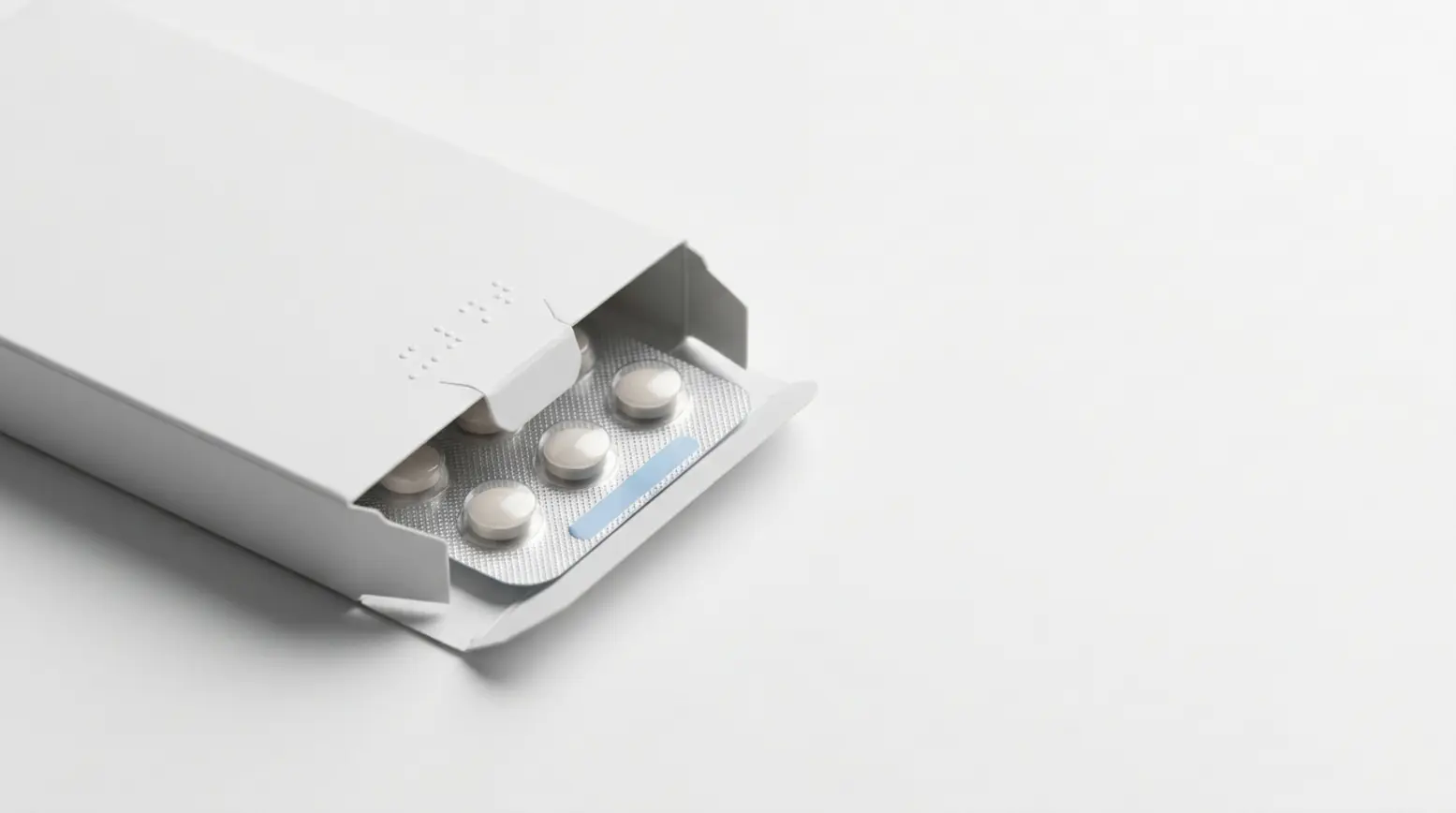

For medicine packs, there is no single set of accessible packaging standards that covers everything. You need to combine the law, formal standards, and practical guidance because each document only addresses part of the job. Although child-resistant testing already checks whether adults can open certain packs, it does not prove full usability, clear instructions, readable text, or complete pharmaceutical packaging accessibility.
• There is no single accessible medicine packaging standard that covers opening, Braille, labeling, and user understanding all in one place.
• ISO 17480 packaging guidance is useful for easy opening, while ISO 17351 is essential for Braille on medicinal product packaging.
• ISO 19809 and ISO 22015 should not be used as medicine compliance rules because both explicitly exclude medicinal products.
• ISO 8317 and 16 CFR 1700.20 already include adult-use checks, meaning child resistance and accessibility overlap in terms of opening performance.
• Buyers should write measurable pack requirements because broad terms like accessible or user-friendly do not provide sufficient proof.
Why accessible packaging standards are harder to map than child resistance
Many teams search for accessible packaging standards because they want one clear answer for medicine packaging. In practice, however, the topic is highly fragmented. Child resistance is easier to map because the test routes are clear and the pass criteria are well defined. Accessibility is much broader, encompassing opening force, readable text, tactile features, information order, instructions, and ease of understanding. As a result, accessible packaging standards are often confused with packaging accessibility regulations and voluntary guidelines.
This distinction matters deeply for medicines because their regulatory scope is exceptionally strict. Some documents may sound relevant based on their titles, but they do not actually apply to medicinal products. Others cover only a single, narrow topic, such as Braille. Therefore, the safest route is to sort every document by type first and then verify whether it truly applies to your specific pack type, target market, and product category.
How to sort accessible packaging standards into law, formal standards, and guidance
Law: what is mandatory
The law establishes the required rules for a given market. In the United States, child-resistant packaging sits within the legal framework of the Poison Prevention Packaging Act, with testing conducted under 16 CFR 1700.20. In Europe, one clear medicine packaging requirement is the inclusion of Braille for the product name on the packaging, subject to specific rules and exceptions. These are prime examples of packaging accessibility regulations. They are not merely design advice and must be treated as mandatory wherever they apply.
Formal standards: what has a defined scope
Formal standards describe a subject with a specifically defined scope. That scope is critical because a broad title does not guarantee that the document applies to medicines. For this reason, teams should always read the scope before including a standard in a specification. If the standard specifically excludes medicinal products, it should never be presented as a medicine compliance rule, even if some of its concepts remain helpful for design work.
Guidance: what can support design work
Guidance is still highly useful because it helps teams improve inclusive packaging design, opening logic, and overall information clarity. However, guidance does not establish compliance on its own. While a supplier might use it to explain certain design choices, they should not present it as formal proof unless the pack was successfully tested under a relevant standard or legal protocol.
The table below provides a practical map of the main documents and their respective limitations.
| Document | Type | Applies to medicines | Main topic | Limits |
|---|---|---|---|---|
| 16 CFR 1700.20 | U.S. legal test protocol | Yes, where applicable | Child resistance and senior adult use | Does not prove full accessibility |
| ISO 8317 | Formal standard | Yes, for relevant child-resistant reclosable packs | Child resistance and adult accessibility for opening | Focused on the tested pack type and opening performance |
| ISO 17480:2015 | Formal standard | General reference, relevant to medicines | Accessible package opening | Not a full pharmaceutical compliance framework |
| ISO 17351:2013 | Formal standard | Yes | Braille on medicinal product packaging | Covers one part of accessibility only |
| ISO 19809:2017 | Formal standard | No | Accessible information and marking | Excludes medicinal products and medical devices |
| ISO 22015:2019 | Formal standard | No | Handling and use | Excludes medicinal products and medical devices |
Which accessible packaging standards actually apply to medicine packaging
ISO 17480:2015 for accessible opening
ISO 17480:2015 serves as the primary general reference for accessible opening. It is often the most relevant easy-open packaging standard when a team wants to design a pack that people can open more easily and consistently. It provides requirements and recommendations for package opening and includes methods to evaluate its practical use. Because of this, it is highly useful when writing design inputs or reviewing a pack concept. Still, it is not a complete accessible medicine packaging standard that covers all regulatory, visual, and cognitive needs.
ISO 17351:2013 for Braille on medicinal product packaging
ISO 17351:2013 is important because it covers Braille on medicinal product packaging. In Europe, the product name must appear in Braille on the packaging, subject to the relevant rules and exceptions. This helps users identify their medicine by touch. However, Braille only covers a single aspect of packaging usability standards. It does not prove that the pack is easy to open, that the printed text is easy to read, or that the opening steps are easy to follow.
Standards that do not apply to medicinal products
ISO 19809:2017 covers accessible information and marking, but it excludes medicinal products and medical devices. Similarly, ISO 22015:2019 covers handling and use, yet it also excludes medicinal products and medical devices. These exclusions are highly important because they dictate how suppliers can describe compliance. While these documents may still offer excellent ideas for inclusive packaging design, they should not be presented as formal pharmaceutical packaging accessibility requirements for medicines.
Where child resistance fits inside accessible packaging standards
ISO 8317 includes adult-use testing
ISO 8317 is a child-resistant standard for reclosable packs that simultaneously checks whether adults can use the package. This means opening accessibility is already built into the protocol for the tested pack type. If you want a broader background on these routes and terminology, our article covering child-resistant packaging certifications explains the larger topic in more detail. The main point here is quite simple: when the issue revolves around opening success, child resistance and accessibility often overlap within a single formal test route.
U.S. 16 CFR 1700.20 includes a senior adult protocol
The U.S. route also incorporates adult-use checks through a defined senior panel, a strict time sequence, and a required success rate. Therefore, this is already part of the foundational proof for opening performance. It is particularly useful when teams want concrete evidence that a tested pack can resist child access while remaining manageable for older adults under standard protocol conditions.
What certified performance can and cannot prove
A supplier may claim certified performance for a specific tested design and can legitimately report the adult-use results for that exact structure. This is a fair and useful claim because the proof is inherently tied to the structure that underwent testing. You can see this testing route fully explained on our page concerning certified child-resistant packaging. However, certification remains highly design-specific. If the physical structure changes, retesting may be needed because the overall performance can change as well.
This distinction is critical for procurement, regulatory, and engineering teams. A certified format does not equate to universal approval for every subsequent version, cavity pattern, or opening feature. Therefore, supplier claims must state the exact test route, the specific design used, and the absolute limits of the result. Clear wording enables teams to compare genuine evidence rather than relying on broad, unsubstantiated claims.
What accessible packaging standards do not cover on their own
Opening success is only one part of usability
While adult opening tests are certainly useful, they do not guarantee full usability. A pack can easily pass an opening test and still suffer from weak contrast, small typography, poor information hierarchy, or confusing instructions. Because of this, accessible packaging standards that focus solely on opening mechanics do not answer every question regarding the real user experience. Teams still require separate checks for visual communication, reading ease, and cognitive clarity.
This is precisely why we maintain a clear line between formal standards and practical product communication. A resource explaining senior-friendly packaging can demonstrate how adult usability functions in practice, but it is not a formal standard in itself. By the same logic, a senior-friendly standard for opening performance does not prove that all other essential accessibility needs have been fully met.
Braille is important, but it is not full accessibility
Braille supports identification by touch, which is incredibly important for medicine use. Still, Braille does not indicate whether the opening motion is manageable or if the printed instructions are actually clear. Therefore, tactile labeling is crucial, but it covers only one part of the broader packaging usability standard picture.
Why buyers need measurable design requirements
When no single set of accessible packaging standards covers the full scope of a project, buyers should define measurable requirements within their design briefs. It helps immensely to separate the opening action, written instructions, visual communication, and intended-user testing. Broad terms like accessible packaging standards or user-friendly packaging are simply too vague on their own. A much stronger brief explains exactly what must be opened, by whom, under what specific conditions, and what type of evidence is considered acceptable.
• What a supplier may reasonably claim: A supplier may accurately claim design-specific, certified child-resistant performance, report the adult-use result for that tested design, and fully explain the test route used.
• What a supplier should not claim: A supplier should never imply that a single certified design proves all future variants are automatically compliant, nor should they claim that child-resistant testing guarantees full accessibility for all users.
How to write better specifications with accessible packaging standards in mind
Split the brief into four requirement groups
Start with the opening action. Clearly define the required force, hand motion, number of steps, and any limits on loose parts if they are relevant. Next, define the instructions and usage steps, noting exactly where the opening cue sits and how easily the user can follow it. After that, outline visual communication requirements, such as color contrast, readable typography, and a clear information hierarchy. Finally, define intended-user testing so the gathered evidence genuinely reflects the people who will be using the pack. This structured approach works well because it transforms broad accessibility goals into practical, measurable checks.
Ask suppliers for design-specific proof
Always ask which test route was used, such as ISO 8317 or 16 CFR 1700.20, and request the actual adult-use result. Clarify whether the provided proof applies to the current structure or an older version. Then, ask what specific kinds of structural changes would trigger a need for retesting. By doing this, procurement teams can compare supplier evidence on a level playing field and confidently challenge vague claims with clear, pointed questions.
Use one tested design as a proof point
A highly useful example is our senior-tested Wallet Box. It is an all-paper pack that holds up to three blister strips, accommodates about 95% of blister formats currently on the market, and runs on standard cartoning lines at normal production speeds. During formal testing, fewer than 1 percent of 300 children could open it, while 100 percent of the senior panel opened it successfully within five minutes. All components stay connected after every opening, which U.S. rules strictly require for primary packaging. While this success fully supports a design-specific claim for that particular tested structure, it does not prove compliance with every possible accessibility or usability requirement.
We apply this same careful logic to our other tested designs. Our Carton uses two diagonal push points to create effective child resistance while keeping the opening motion completely clear for adults. Both our Carton and Wallet Box are fully certified to ISO/EN 8317 and F=1 U.S. 16 CFR 1700.20 for their specific tested designs. If a project requires broader support across the packaging chain, the team behind us can also assist through Ecobliss Pharma, providing expertise in design, packing, serialization, component production, and packaging machinery.
A practical route from standards to a real pack brief
The practical route is entirely straightforward. First, verify whether a document is law, a formal standard, or simply guidance. Next, confirm that it genuinely applies to medicines and your specific pack type. Then, utilize child-resistant adult testing wherever it fits, and add separate, measurable requirements for the specific elements those tests fail to cover. This is the clearest and most effective way to translate standards, guidance, and test data into a highly useful brief for a real pack design.
If you are writing a specification and want to check whether a particular requirement, test route, or supplier claim properly fits your structure, please contact us for a focused review. We would be happy to discuss the exact scope of a specific pack design and the real-world proof needed to reasonably support it.
FAQ about medicine packaging rules
Does passing a child-resistant test mean a package is fully accessible? No. It simply shows that the tested pack met the child-resistant protocol alongside the adult-use component of that specific test. It does not guarantee strong visual contrast, readable text, simple instructions, or overall suitability for every user group.
Does ISO 17480 apply as a legal requirement for medicine packaging? No. ISO 17480 serves strictly as a general reference for accessible package opening. While it is highly useful during design and specification work, it does not represent the full legal framework required for medicine packaging.
Do ISO 19809 and ISO 22015 apply to medicinal products? No. Both of these standards explicitly exclude medicinal products and medical devices from their scope. Therefore, they should never be presented as medicine compliance requirements.
Can a supplier claim one certified design proves all future variants are compliant? No. Certification is intimately tied to the exact design that was tested. If the physical structure changes in any way, retesting may be necessary because the opening performance will likely change as well.
Request a free sample now!


